
Love, Still
Season 9 Episode 20 | 26m 24sVideo has Closed Captions
Love changes. People leave. Time moves on. But some love leaves a mark that lasts.
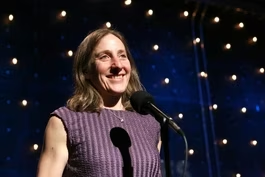
Love changes. People leave. Time moves on. But some love leaves a mark that lasts. Rona Leventhal gently coaxes the words “I love you” from her emotionally guarded dad; Yunus Quddus finds an unlikely best friend in a small alley cat who helps him survive a lonely adolescence; and Julie Seltzer revisits a mysterious connection that proves love can be real, even when it doesn’t last.
Problems playing video? | Closed Captioning Feedback
Problems playing video? | Closed Captioning Feedback
Stories from the Stage is a collaboration of WORLD and GBH.
Love, Still
Season 9 Episode 20 | 26m 24sVideo has Closed Captions
Love changes. People leave. Time moves on. But some love leaves a mark that lasts. Rona Leventhal gently coaxes the words “I love you” from her emotionally guarded dad; Yunus Quddus finds an unlikely best friend in a small alley cat who helps him survive a lonely adolescence; and Julie Seltzer revisits a mysterious connection that proves love can be real, even when it doesn’t last.
Problems playing video? | Closed Captioning Feedback
Where to Watch Stories from the Stage
Stories from the Stage is available to stream on pbs.org and the PBS app.
Providing Support for PBS.org
Learn Moreabout PBS online sponsorshipRONA LEVENTHAL: My dad was 85 years old, a few years retired.
We were finishing up a conversation on the phone, and I just blurted it out.
"Goodbye, Dad-- I love you."
YUNUS QUDDUS: He showed me and made me feel love, something I hadn't felt since my mom left.
JULIE SELTZER: So, a week later, I walk into a coffee shop in Dupont Circle, and I see a woman with short brown hair and glasses, and I fall in love.
WES HAZARD: Tonight's theme is "Love, Still."
Love has a weird habit of not always sticking around in the ways that we expect it will.
Feelings change.
People leave.
Lives take a turn.
Time moves on.
Yet, despite its changeable nature, love does have a way of remaining.
Tonight, our storytellers are going to share moments when love changed them in ways that continue to endure.
♪ ♪ LEVENTHAL: My name is Rona Leventhal.
I live in the western part of Massachusetts, in the Northampton area, and I've been a professional storyteller for 36 years.
And I'm wondering, you know, in your experience, 36 years of doing this, what do you find that audiences most respond to out of folktales?
What is it that causes them to be compelling?
LEVENTHAL: Yeah, good question-- so, folktales, um, have a lot of truths to them, universal truths, and also a lot of cultural information in them.
They've been around for so long because they are so universal.
Okay.
LEVENTHAL: So even though they're folktales, people personalize the stories.
They take those things out of the, the story, out of the folktale, that they can relate to in their own lives.
Personal stories do the same thing, but from the opposite direction.
So a personal story is obviously my story that I'm telling, but they are universal in the telling of them.
When our audience listens to your story, what would you most hope that they listen for?
LEVENTHAL: So, in any story that I tell, I want my audiences to take away either "Aha!"
or... (sighs) Or both.
(laughs) So that's what I aim for.
♪ ♪ My father came from a generation of men who had one thing in common: avoiding emotion.
(audience chuckles) At least emotions of the heart.
So I don't know what I was thinking.
Clearly, I wasn't thinking when I just blurted it out.
My dad was 85 years old, a few years retired.
We were finishing up a conversation on the phone, and I just blurted it out.
"Goodbye, Dad-- I love you."
Now, this may not seem very strange to you, but it occurred to me at that very moment that my father never said those words to me.
Now, unlike the movies, my father did not melt.
He did not burst open from my outpouring of love.
He did not even smile.
He just said... (gruffly): "Yeah, ditto."
(audience laughing) I said, "Ditto?
What do you mean by that, Dad?"
(laughing): "You know, ditto."
"No, Dad, what does it mean?"
(laughing): "You know!
I don't want to say it."
(audience laughing) We were sitting 1,000 miles apart from each other.
I was in Massachusetts, he was in Florida.
Our cheeks were wet with tears.
Our mouths were tired from smiling.
Laughter was pulsating over the telephone wires.
I let him off the hook-- this time.
My dad was 85 years old, sharp as a tack.
He remembered every card that I put down on the table when I played gin with him.
But he conveniently developed an acute case of amnesia every time I asked him to reply in kind with those three words, "I love you."
And so this bantering back and forth became a regular part of our conversations.
Now, when we spoke, there was a certain rhythm to it anyway.
We would start off by talking about his bowling game, his tennis game, his emphysema, and his breathing, at which point he'd very distinctly turn the focus onto me.
Enough about him, what about me?
And then the conversation went something like this, and I will decode this for you.
"How's your car running?"
(audience chuckling) A very important topic to my father.
(audience chuckling) "How's your social life?"
He always said that he wanted to see me get married before his last days on this Earth.
And I would say to him, "Well, Dad, "I guess I'm doing a pretty good job, "because me staying single is keeping you around a little bit longer."
(audience laughing) (softly): "Uh, any work on the fire?"
He would always say this softly, so that my mother wouldn't hear.
You see, this was code for asking me for a brief report of my financial status and to see if a clandestine money transfer was necessary.
(audience laughing) And that was it.
"Goodbye, Dad-- I love you."
(gruffly, laughing): "Yeah, same here."
"Come on, Dad, it's not going to kill you to say it."
(laughing): "You know what I mean."
He was cracking up, I was cracking up.
And I could hear him and see him as if he were sitting right in front of me with his big ears and his big nose turning beet red.
"Come on, Dad, I want to hear you say it."
(laughing): "Leave me alone already.
"You're nuts, you know that?
(laughs) "And beside, uh, I can't.
I, I don't want to say it in front of Mom."
(audience chuckling) Said, "Oh, no, you wouldn't want to show any emotion in front of her, all right."
He said, "That's right."
(audience laughing) Now, my mother had supersonic hearing and an innate ability to know exactly what was going on at any point in time.
And somehow, through the breathy staccato of my father's laughter, she knew exactly what we were talking about.
And I could hear her in the background saying, "Good luck getting him to show any emotion."
But when she left the room, I heard the voice on the other side of the line saying... (whispering): "Yeah, okay.
I love you."
He was cracking up, all right, but he was also cracking open.
This was big news!
Headline news for my family!
I went and I told my sister, she said... (scoffs) "He never told me that he loved me."
(audience laughing) "You never asked," I replied.
One year, on Fathers' Day, I said, "You know, Dad, "I was gonna get you a card that said, 'I love you, I love you, I love you, I love you.'"
(laughing): "That's your line."
"No, Dad, that's your line."
"Yeah, yeah, yeah, that's okay-- good night."
But he was cornered.
My mother was in the room with him.
I was on the phone with him.
And in front of my mother, he said, "Yeah, okay, I love you.
You see, Evie?
I said it."
And I could hear my mother in the background saying, "I can't believe it!
I'm giving him a big kiss for you."
Now, I don't know exactly when it happened, but there came a time, a moment, when I realized what I had done.
"Goodbye, Dad-- I love you."
"I love you-- you know I do.
"I always have, I always will.
I love all my kids, you know that."
And as I hung up the phone and let the couch envelop me and let the tears run down my face, I realized that the crack had opened fully.
Five years passed since I've started this bantering with my father, and he was turning 90.
And we made him a great surprise birthday party.
Everything about it was perfect.
There was a, a cake with a tennis theme, party favors, and a special party hat for the birthday boy.
Even the look on his face as he entered the room and screamed without saying a word, "What the hell is going on here?"...
(audience chuckling) ...was perfect.
After the meal, people gave tribute to my father, and I was the last one to go.
And I fumbled my way through a list of things I thought were important to say.
But I didn't need a script for the grand finale.
I turned to my father.
"Okay, Dad, are you ready?
"We've been practicing for five years.
"We've been waiting for this very moment for five years.
Are you ready?"
He nodded at me-- he knew exactly what I meant.
"I love you, Dad."
"I love you."
And that room burst into cheers as 50 people witnessed this opening in my father.
And no one needed any explanation.
Everyone knew my dad.
Now, back then, and even still today, I so appreciate that shapeshifting father of mine as he aged and mellowed.
And perhaps what this story is about is that a little chutzpah goes a long ways.
Or maybe it's that sometimes, we have to just go for things without thinking.
And, you know, I still have this conversation with my father, even today, even decades after his last days on this Earth.
Only now, I talk to the moon.
And it's as if the light reflecting off the moon fills the empty places in my heart.
And sometimes, as I'm walking along, I can hear my father's voice whispering in my ear, "I love you.
I always have, I always will."
(cheers and applause) ♪ ♪ QUDDUS: My name is Yunus Quddus.
I'm from Providence, Rhode island, which is 40 minutes from Boston, and I'm an actor, a storyteller, and a poet.
Can you tell me about how you first started telling stories?
QUDDUS: I would say as a kid, my dad was a poet, so I had to... I wanted to get his attention.
I wanted to get in, into his world.
So I started writing poems and trying to merge stories into these poems, and they had to be amazing to stop him so he would listen, because he worked a lot.
So that's where I think I started.
Can you tell me a little bit about the creative spirit in the house?
You said your dad was a poet.
Yes, so, my dad was a, a poet, and he would have these intricate stories and, and poems and mix life and music with all of these things going on.
And so in my house, you would hear jazz, you would hear Last Poets, you would hear things like that.
You know, and then, growing up on hip-hop, I grew up in hip-hop, so I had all of that creative juice, like, around me to inspire me.
What kind of stories are you most drawn to tell?
I would say inspiration and, and joy and comedy.
I love characters.
I love to tell fun, funny stories and inspirational stories to kids that give them hope.
When I was 16, my life fell apart.
My parents got divorced.
And to make matters worse, I was that weird kid, quiet kid, scared of everything, too gentle for the world I was suddenly placed in.
Now, my parents thought I was old enough to handle it all.
I wasn't.
After my parents got divorced, I moved into a house with my dad that he bought in Philadelphia.
A new city, a new school, and a neighborhood that didn't hide its dangers.
It sat on your front porch like it paid the rent.
I'll never forget the address.
169 Seymour Street.
No heat, no insulation, plastic on the windows, and a kerosene heater that made the entire house smell like a gas station.
My dad worked two jobs.
He left before I opened my eyes and came home long after I closed them.
So, at 16, in a three-story house, I realized I had to raise myself.
And outside was war.
The neighborhood had all the perfect ingredients for the ghetto: gangs, drug dealers, and then there was Dwayne.
Dwayne was a 26-year-old man who bullied teenagers like it was his full-time job.
(audience chuckling) Every weekend, I avoided Dwayne like he was a devil coming after my soul.
But school was a different kind of torture.
Freshman year at Germantown High School.
Everything I wore came from the thrift store.
I even had reversible pants and a reversible jacket.
Wednesdays I was gray, Thursdays I was black, Mondays and Tuesdays... I skipped school on those days.
(audience chuckling) I didn't have enough clothes to fill in those days.
And Friday was my one good shirt day.
The one day I felt like I could be normal and I could fit in.
Until a kid pointed at me in the hall and said, "Yo, that's my old shirt.
(audience chuckling and murmuring) My mom donated that to the thrift store."
From that point on, every Friday became a rerun of humiliation.
By the end of the week, walking home, I felt alone.
Then I heard behind me, "Yo, get him!"
I took a quick glance.
Ten feet, ten people coming towards me.
Ten kids looking to jump me like it was after-school sports.
My first instinct, and my greatest talent at that time, was to run.
I was fast.
I ran like survival was the only thing I had ever learned.
Through alleyways, over fences, across train tracks, until finally, I lost them.
I stopped in the middle of an alley to catch my breath with the weight of the world on my chest.
And that's when I saw him.
A tiny alley cat with the smallest tail I'd ever seen.
He looked at me like he knew me.
I whisper to him, "Hey, little guy.
"Hey, little kitty, kitty, kitty.
What you doing out here all by yourself?"
And I pet him, and he purred and showed me some love.
After five minutes, I stood up, and I said, "Okay, little guy.
Be careful out here-- I'll see you later."
But when I turned to walk away, he followed me.
One block, two blocks.
I turned around and said, "What are you doing, man?
You can't come home with me."
And he purred and meowed and said... (imitates cat trilling) "Once you pet me, I'm yours."
(audience laughing) So, I picked him up, I tucked him into my hoodie, and I realized I didn't have to be alone anymore.
I named him Alipookala.
Later on that night, holding him tight, I made up a song.
♪ Alipuka, that's my baby ♪ And he purred like he understood every word.
Freshman year came, I survived.
I still ran from bullies.
I still avoided Dwayne.
I still hid my pain.
But every day after school, there he was, waiting for me.
Short tail sticking up, eyes glowing, purring like he counted every second I'd been gone.
Now, I didn't talk to people much, but I talked to him.
I didn't sing in public, but I sang his song.
He showed me and made me feel love, something I hadn't felt since my mom left.
Sophomore year came, and things changed.
I learned the alleyways, the shortcuts, and the rooftops.
But Alipookala taught me something bigger: courage.
He was the smallest cat in the neighborhood, but he feared nothing.
So, when I wanted to give up, I pictured him waiting for me at the door.
And I kept going.
I started writing my poems, my dreams, my fears, and my secrets.
And he'd sit and listen like he understood every word.
He even taught me the funniest lesson on love.
I saved up for two weeks to buy a cheesesteak.
I sat it down for a second, went downstairs to get some ketchup, and when I came back, Alipookala had eaten almost the whole thing!
(audience laughing) I yelled at him, like, "Bro!
What the heck, Alipookala?
I was gonna share some with you."
He looked at me, he know he messed up, and ran and hid under the dresser.
I let it go, because I realized that love messes up sometimes, but real love stays.
And he stayed.
Then junior year came, but the world started whispering things I didn't want to hear.
Alipookala stopped running to the door.
He stopped sneaking out the cracked third-floor window.
He stopped stealing my food, he slept more, he hid more.
I knew something was wrong, but I didn't want to face it.
I searched the whole house-- I couldn't find him anywhere.
My brother came over to help.
He found him dead in the closet.
My cat had gone away to die alone because he didn't want to upset me.
My brother told me gently, but it broke something inside of me.
He buried him in the backyard with one paw facing the sky, like he was holding the last piece of my childhood to say goodbye.
I didn't cry, but I was shattered.
Alipookala didn't just love me.
He taught me to love myself.
He taught me to be strong.
He taught me it was okay to be weird and be different.
He taught me that the weird ones, the quiet ones, the gentle ones, the kids who are getting bullied one day will grow to something beautiful once we learn to stand up and love ourselves.
And that's why God put Alipookala in my life.
And that's why he left.
And that's why I'm here telling you his story.
Alipookala, I love you, man.
(audience murmuring) Thank you.
(cheers and applause) ♪ ♪ SELTZER: My name's Julie Seltzer.
I grew up outside of Philadelphia, Pennsylvania, and I currently live in the Hudson Valley, New York, in a town called Beacon, and I work as a Torah scribe.
Well, first question, what exactly is entailed in being a Torah scribe?
Can you talk about that?
I basically transcribe the Torah, which is the first part of the Hebrew Bible.
I write with a feather and ink on parchment, and I'm copying it from an existing copy.
What do you enjoy most about being a Torah scribe?
I love that I get to be in a conversation that transcends time and space.
And so, I get to think about people that lived before me, people that will live after me, what the world was like before I was here, what it will be like after I'm gone, and kind of feel part of that chain of transmission.
What about personal storytelling most appeals to you?
I like that storytelling is kind of a combination of writing and performing.
And I also love that I get to surprise myself and talk about really vulnerable things that I probably wouldn't even tell my closest friends in another context, and here I am sharing them with a large room of people.
It's the summer of 1990, and I'm a camp counselor at my favorite place in the whole world, Camp Timber Tops for Girls.
(audience chuckling) And a few of us are sitting in the mess hall when this kind of dorky counselor comes over and says-- in retrospect, somewhat flirtatiously-- "I can read your mind."
Now, I am just this side of agnostic on a good day, and I don't believe in magic-- I believe in science.
So when she says, "I can read your mind," I say, "Oh, yeah?
Let's test that.
What number am I thinking of, between one and 20?"
And she says, "Four," which was the number I was thinking of.
"What color am I thinking of?"
And I think of blue.
And she says, "Blue."
(audience murmurs) "Okay, what song am I thinking of?"
And I think of "Cat's in the Cradle."
And I look into her eyes, and she looks into mine, and she says, "'Cat's in the Cradle.'"
Okay, this is getting a little bit weird.
(audience chuckling) "How about this?
I'm going to think of a name from this list."
It was a list of the color war teams.
There must have been a hundred camper names on this list.
And I close my eyes and I beam the name Mindy Stein from my brain directly into her brain, and she says, "Mindy Stein?"
Oh!
She's reading-- she's reading my mind!
Amy, Amy is reading my mind-- I am freaking out.
And at this point, she doesn't believe me that I'm telling the truth.
So I say, "Well, let's get someone else.
"Sherry, I'm going to think of a food, "and I'm going to tell you what food I'm thinking of.
And then Amy's going to guess."
At this point, we have something of a crowd, so we take it outside to the field, and we stand 20 feet apart from each other.
And I say to Sherry... (softly): "I'm thinking of spaghetti.
"But if she says chicken, it still counts, because for some reason, chicken keeps crossing my mind."
(audience laughing) And I look across the field at her, and she looks across the field at me, and I focus on spaghetti, even though chicken keeps crossing my mind.
(audience laughing) And she says, "I'm kind of getting two things.
(audience laughing) Chicken and spaghetti?"
(laughter continues) (exclaims) And we lose it.
And now, from this point forward, whenever someone would ask, do I believe in E.S.P.
or telepathy or the supernatural, I would say, "No, but I did have this one very bizarre experience."
And about 15 years later, I would have yet another bizarre experience that would yet again challenge my more skeptical nature.
I'm living at this point in Washington, D.C.
It's the early 2000s.
And after a breakup, my housemates suggest I try online dating.
So I dial up to nerve.com and I go to the lesbian section, which is basically adult Camp Timber Tops for Girls.
(audience laughing) And I browse through the profiles, and I browse.
Months go by.
Eventually, I see this one profile I simply must respond to.
There's no picture, but there's something about not even what she says, but how she says it that I am inexplicably drawn to.
So a week later, I walk into a coffee shop in Dupont Circle, and I see a woman with short brown hair and glasses, and I fall in love.
It's hard to explain the feeling.
It was as if I already knew her from a previous life.
But the problem was, I don't believe in love at first sight, and I don't believe in past lives.
And I know that intuition is just our brains making predictions based on past experience, and they're often incorrect.
But this time, I was right.
And we don't technically do the U-Haul thing, but from our second date, we jump right into a relationship.
And it is amazing.
About six months in, we're laying in bed one morning, and she says something, and I'm, like, "That's so funny, I was just thinking the exact same thing.
And she says to me, somewhat flirtatiously, "I can read your mind."
(audience laughing) And I'm, like, "Oh, my God, did I ever tell you "this thing that happened to me at camp?
"There was this counselor who kept reading my mind over and over."
And as I'm telling her the story, her eyes are getting wider.
And suddenly I see that dorky counselor looking back at me.
And we realize in the same moment that we were the ones to have that telepathic experience with each other.
And we leap out of bed and we scream!
I mean, this was something beyond scientific understanding.
Now it's even weirder that my name is Julie Amy and her name is Amy Julie.
(audience laughing) This was something metaphysical, it was something spiritual, it was something magical.
It was also something that ultimately she didn't want, because she broke up with me that summer.
(audience groans) I stayed in D.C.
another year, lived abroad for a number of years, and when I moved back to the States, I went to Brooklyn, New York.
And either happenstance or something more would find me an apartment just one block away from where she had moved, apparently.
With her new girlfriend, who she would marry.
All the magic in the world didn't mean it was meant to be.
But I still wonder about that experience.
Was it just a series of highly unlikely coincidences?
Or was there something more?
Telepathy?
Precognition?
Maybe something scientific we don't yet understand.
I don't know.
But I do know that love is mysterious.
And now when people ask if I believe, I say, "I'm not sure.
But I'm open to the mystery."
Thank you.
(cheers and applause) ♪ ♪
Video has Closed Captions
Preview: S9 Ep20 | 30s | Love changes. People leave. Time moves on. But some love leaves a mark that lasts. (30s)
Providing Support for PBS.org
Learn Moreabout PBS online sponsorship
- Arts and Music

Join the legend for a musical journey through the people and places that shaped her career.

 New Episode




 New Episode


Support for PBS provided by:
Stories from the Stage is a collaboration of WORLD and GBH.