
July 22, 2026 - PBS News Hour full episode
7/22/2026 | 57m 46sVideo has Closed Captions
July 22, 2026 - PBS News Hour full episode
July 22, 2026 - PBS News Hour full episode
Problems playing video? | Closed Captioning Feedback
Problems playing video? | Closed Captioning Feedback
Major corporate funding for the PBS News Hour is provided by BDO, BNSF, Consumer Cellular, American Cruise Lines, and Raymond James. Funding for the PBS NewsHour Weekend is provided by...
July 22, 2026 - PBS News Hour full episode
7/22/2026 | 57m 46sVideo has Closed Captions
July 22, 2026 - PBS News Hour full episode
Problems playing video? | Closed Captioning Feedback
Where to Watch PBS News Hour
PBS News Hour is available to stream on pbs.org and the PBS app.
Providing Support for PBS.org
Learn Moreabout PBS online sponsorshipGEOFF BENNETT: Good evening.
I'm Geoff Bennett.
AMNA NAWAZ: And I'm Amna Nawaz.
On the "NewsHour" tonight: President Trump dramatically escalates threats against Iran, as the bodies of four American soldiers killed in the war are returned to the U.S.
GEOFF BENNETT: The U.S.
and Saudi Arabia have agreed to a deal that would allow the kingdom to enrich uranium for nuclear power, raising concerns about the potential for weaponization.
AMNA NAWAZ: And Trump loyalists and election deniers win primaries in Arizona.
The implications for the midterm elections.
STEPHEN RICHER (R), Former Maricopa County, Arizona, Recorder: This has real-world downstream effects, the very least of which is that a lot of people won't have confidence in our elections.
(BREAK) AMNA NAWAZ: Welcome to the "News Hour."
As we come on the air tonight, Iranian news agencies are reporting widespread aerial attacks across Southern Iran.
The U.S.
has carried out strikes on the Islamic Republic for the last 11 nights straight.
It has yet to confirm a 12th night of strikes tonight.
GEOFF BENNETT: President Trump today leveled more threats against Iran, and the Islamic Republic's foreign minister responded that any future attacks would be met an eye for an eye, as the contested closure of the Strait of Hormuz continues.
Our White House correspondent, Liz Landers, reports.
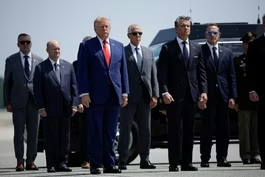
LIZ LANDERS: This morning, on his way to receive the bodies of four U.S.
soldiers, President Trump vowed revenge.
DONALD TRUMP, President of the United States: They're going to pay a big price.
LIZ LANDERS: It followed yet another threat from the president to attack civilian targets -- quote -- "Any time the Islamic Republic of Iran shoots at a ship in the Strait of Hormuz, whether it be by missile, rocket, drone, or any other device or weapon, the United States will bomb and destroy one bridge or power plant."
The U.S.
military in recent days has already attacked bridges in Iran, and state media claims the U.S.
also hit a power plant on Sunday.
Such targeting of civilian infrastructure could be considered a war crime.
Iran has also struck civilian targets across the Gulf.
An Iranian strike hit this desalination plant in Kuwait.
Most of Kuwait's freshwater supply comes from converted seawater.
President Trump's threats come as the U.S.
has attacked the country for 11 consecutive days.
Despite the barrage, America's top diplomat, Secretary of State Marco Rubio, said today the U.S.
is still pursuing diplomacy, but sent a message of his own.
MARCO RUBIO, U.S.
Secretary of State: The president always prefers to negotiate and reach a deal on these things.
And we're prepared, willing to do that.
We have tried to do that now for a year-and-a-half, but we're also not going to sit by and let ships be blown up or Americans be attacked.
LIZ LANDERS: On the strait, the U.S.
Navy has restarted its blockade, redirecting nine ships and disabling one since July 14.
The renewed fighting is once again spiking oil prices.
The June cease-fire provided only a brief reprieve.
Now the cost of a barrel is back near $95.
For its part, Iran launched yet another wave of strikes across the Gulf this morning, seen in these volleys targeting U.S.
bases in Jordan.
And on the ground in Southern Iran, grief from the early days of the Iran war.
Mourners surrounded small coffins for a final farewell, newly identified victims of a strike on a girls' school that killed over 100 children in the first bombings of the war.
Back home on U.S.
soil, the dignified transfer of four U.S.
service members.
All were killed in the last week.
President Trump stood silent for one of the most solemn moments of any presidency; 25-year-old 1st Lieutenant Tyler James Feehan was killed in a missile attack in Jordan, along with 28-year-old Sergeant Angel S. Rampersad, and 19-year-old Private Isabella Gonzales; 30-year-old Staff Sergeant Michael Emmanuel Swinton was killed in a control detonation of a drone in Iraq.
Since the war began in late February, 18 U.S.
service members have been killed, four of whom made their final trip home today.
For the "PBS News Hour," I'm Liz Landers.
GEOFF BENNETT: Well, as the war with Iran escalates, the U.S.
and Saudi Arabia today announced a landmark nuclear deal that would give the kingdom access to American technology for a civilian nuclear energy program and could allow Saudi Arabia to enrich uranium.
AMNA NAWAZ: The U.S.
describes the deal as helping to launch an era of American nuclear renaissance.
But critics say the deal could lead to further nuclear proliferation.
Nick Schifrin has more.
NICK SCHIFRIN: He is one of the Middle East's youngest leaders, expected to lead for the next half-century the world's largest oil exporter.
And, today, Saudi Crown Prince Mohammed bin Salman achieves one of his long-held goals, a civilian nuclear deal with the United States.
It's a 30-year deal for exclusively American companies to build nuclear infrastructure in Saudi Arabia, including, if a joint study concludes it's commercially viable, a uranium enrichment facility.
"These agreements uphold the highest standards of nuclear safety and nonproliferation, while relying on the world's best nuclear technology and scientists designed right here in the United States," Secretary of Energy Chris Wright today said in a statement.
"Thanks to President Trump, the American nuclear renaissance is under way."
The deal comes as the U.S.
is escalating its attacks in Iran in a war whose goal President Trump describes as preventing Iran from having the ability to create a nuclear weapon.
DONALD TRUMP, President of the United States: Any site where they're even thinking about nuclear, we will be hitting it very, very powerfully.
NICK SCHIFRIN: But the deal provides Saudi Arabia U.S.
nuclear technology, even though it does not include what's known as the U.N.
nuclear agency's additional protocol of monitoring and inspections, and even though bin Salman in 2018 did not rule out eventually building nuclear weapons.
NORAH O'DONNELL, CBS News Anchor: Does Saudi Arabia need nuclear weapons to counter Iran?
MOHAMMED BIN SALMAN, Saudi Arabian Crown Prince (through translator): Saudi Arabia does not want to acquire any nuclear bomb.
But without a doubt, if Iran developed a nuclear bomb, we will follow suit as soon as possible.
SEN.
EDWARD MARKEY (D-MA): This is about a clandestine nuclear weapons program on their ground.
NICK SCHIFRIN: That's led to a yearslong debate in Congress, where some Democrats describe the kingdom as a threat to nuclear proliferation.
SEN.
EDWARD MARKEY: If we put in place an agreement that allowed for uranium enrichment or plutonium reprocessing on the land of Saudi Arabia, it would be potentially disastrous.
NICK SCHIFRIN: The deal is also opposed by Israeli leaders, including one of the leading opposition candidates in the upcoming elections, Naftali Bennett.
NAFTALI BENNETT, Former Israeli Prime Minister (through translator): The nuclear agreement taking shape with Saudi Arabia over Israel's head is a severe strategic failure that endangers our security.
Enrichment of nuclear material on Saudi soil could lead to a regional nuclear arms race and a dangerous loss of control.
NICK SCHIFRIN: But the State Department, in a may letter to Markey, said the U.S.-Saudi deal includes a bilateral safeguards agreement to be implemented with the International Atomic Energy Agency that provides for the application of additional safeguards and verification measures to provide added confidence in the exclusively peaceful use of material and equipment.
BERNARD HAYKEL, Princeton University: It's been a very big goal for the Saudis.
For a long time, they have wanted to have nuclear power to be able to release more oil for exports.
NICK SCHIFRIN: Bernard Haykel is a Princeton professor of Near East studies and a Saudi expert.
He argues, since the kingdom started developing green energy, nuclear energy no longer makes any sense.
BERNARD HAYKEL: When it comes to power generation, it's 10 times more expensive than solar power because they are blessed with an unbelievable amount of sunshine.
So, frankly, if you're looking to generate power to liberate more oil from electricity generation, it makes much more sense to use a combination of solar, wind, and gas, natural gas.
NICK SCHIFRIN: And yet bin Salman is getting the deal he wanted and tying the kingdom to the United States for the next generation.
For the "PBS News Hour," I'm Nick Schifrin.
GEOFF BENNETT: For perspective on this, we turn now to Jon Wolfsthal.
He was an adviser to the Biden administration on U.S.-Saudi nuclear cooperation and was on the National Security Council staff during the Obama administration.
He's now a fellow at PAX sapiens.
That's a nonprofit focused on preventing foreseeable global catastrophes.
Great to have you here in the studio.
JON WOLFSTHAL, Former Biden Administration Adviser: Thanks for having me.
GEOFF BENNETT: So, based on what's been reported, is this a good deal for the U.S.?
JON WOLFSTHAL: I haven't seen the details under the hood of this deal, and until I do, I'm really going to wait and reserve judgment.
The proof's always in the pudding.
And so what are the conditions in the deal?
Do they actually bind the Saudi Arabians to only buy U.S.
technology in perpetuity?
What are the criteria by which we will judge whether or not they will get to do domestic enrichment?
And, most importantly, what sort of access will the International Atomic Energy Agency have throughout Saudi Arabia in case we find something suspicious?
GEOFF BENNETT: The administration says this is about helping Saudi Arabia develop civilian nuclear power.
How quickly can civilian enrichment capability become a pathway to a weapon?
JON WOLFSTHAL: So right now, the Saudi Arabians don't have the ability to produce their own uranium enrichment equipment.
They don't have the technology.
And if they wanted to buy it from the United States, we don't currently have a viable commercial technology.
So we're still several years away from being able to provide it or the Saudi Arabians being able to build it.
So this is not a weapons program with a flip of a switch.
If the Saudi Arabians are trying to pull the wool over people's eyes and go nuclear, it's many years down the road, but something we have to be watchful for.
GEOFF BENNETT: When the Saudi crown prince says that, if Iran develops a nuclear weapon, Saudi Arabia will do the same, how confident can the U.S.
be that Saudi enrichment would remain exclusively peaceful?
JON WOLFSTHAL: I think we have to be extremely skeptical that that's the case, one of the reasons I think the agreement should not authorize enrichment in Saudi Arabia.
And there are options beyond that.
The Saudis could invest in a U.S.-based facility.
There could be a multinational facility somewhere else.
But one of the reasons that you don't want a Saudi Arabia-based facility is because they have said, if Iran goes nuclear, they will too.
I'm also very concerned, however, that the Saudis have relationships with Pakistan that has a nuclear weapons program.
And they could buy equipment from China, which has a nuclear weapons program.
So the question is not, do they do business with us and nobody else, is, if they do business with us, are they less likely to develop a nuclear weapon if they do business with the Chinese or the Pakistanis?
GEOFF BENNETT: And if this deal goes forward with weaker safeguards than previous U.S.
governments had demanded, what precedent does that set?
What stops Egypt or Turkey or some other regional power from saying, hey, if Saudi Arabia can do this, we want to be able to do the same?
JON WOLFSTHAL: I think there are two immediate implications.
One is, the Obama administration, we negotiated an agreement with the United Arab Emirates that said no enrichment, no reprocessing, and you had to have the additional protocol.
But it also said, if you negotiate another deal with another Middle East state that isn't as good, we get to go back and renegotiate.
So the UAE is calling the Trump administration today, I guarantee it, and saying we want another look at this.
And the other is, of course, that if the U.S.
is saying, well, this is the best we can do, other states, whether it's China, Russia, Pakistan or elsewhere, are going to say, well, if the U.S.
doesn't set a high bar, why should we?
GEOFF BENNETT: The U.S.
on the one hand is using military force to prevent Iran from maintaining enrichment capability, and then on the other hand is allowing Saudi Arabia to develop one, effectively.
How does the U.S.
government justify that distinction?
JON WOLFSTHAL: I don't know.
I wouldn't be able to do it.
Under the Obama administration, there was very limited, curtailed enrichment in Iran, and we did not allow enrichment in Saudi Arabia.
I think what the Trump administration will likely argue -- and I think there's a valid point to it -- is, if the Iranians think the Saudi deal is so advantageous, we will negotiate the same deal with Iran, that if they forego their own domestic enrichment, if they only do it in joint projects with the United States with our safeguards on it, then perhaps we could have a discussion.
But that's not what the Iranians are holding out for.
They're saying, it's our enrichment under our terms no matter what.
And that's something that the United States under President Obama, Biden, and Trump have said is not acceptable.
GEOFF BENNETT: We have got about a minute left.
What happens next?
Congress technically has a role to play here.
JON WOLFSTHAL: That's correct.
In fact, the agreement has to sit in front of Congress for 90 days of continuous session.
Under normal circumstances, that's about six months.
It looks like, however, the Trump administration is going to try to jam this through both this Congress, so that they can give approval to Saudi Arabia for enrichment in the -- on the kingdom in the rest of their term, within the next two years.
And I think Congress has to weigh in here, and the question will be, how serious are the questions they're going to ask, and how responsive is the Trump administration?
GEOFF BENNETT: Many more questions to come.
We will have to have you back.
Jon Wolfsthal, thanks again.
JON WOLFSTHAL: Thanks so much.
AMNA NAWAZ: In the day's other news: Tropical Storm Bertha made landfall on the southern coast of Louisiana this afternoon about 40 miles east of New Orleans.
Satellite imagery shows the sheer size of the storm, with winds stretching as far as 100 miles from its center.
Officials are warning of dangerous storm surge and damaging wind, even as Bertha weakens moving westward across the Gulf Coast.
In a press conference today, Louisiana's governor said the state is prepared for the worst, though the storm is not expected to cause major damage.
GOV.
JEFF LANDRY (R-LA): Today's forecast is encouraging, but it doesn't mean that we should be complacent.
I expect every level of government to stay focused on, and that's its core responsibility of protecting people and maintaining the critical infrastructure.
AMNA NAWAZ: Meantime, flash flooding has swamped homes and businesses in West Virginia, with up to seven inches of rain falling in some areas.
Governor Patrick Morrisey declared a state of emergency for all counties and sent more than 300 National Guard troops to affected areas.
Emergency crews on the other side of the Atlantic are battling conditions of a different extreme.
Wildfire has engulfed entire homes in Turkey, while, in the mountains of Sicily, towns were surrounded by a wall of smoke.
In Spain, a fire in Guadalajara, north of Madrid, has burned some 80,000 acres and forced more than 1,200 people to evacuate.
It's now the country's second largest wildfire on record.
Today, Spain's prime minister visited the fire zone.
He said, compared to this time last year, the number of wildfires in Spain has quadrupled.
PEDRO SANCHEZ, Spanish Prime Minister (through translator): Spain needs a major state pact against the climate emergency, because we cannot only think about wildfires when they occur.
We have to act beforehand.
This is not about politics.
It is not about ideology.
It is science.
AMNA NAWAZ: The fires come in the middle of a still sweltering summer across Europe.
In France, public health officials say there were upwards of 5,700 more deaths than usual during a record-setting heat wave last month.
This year's cyclosporiasis outbreak in the U.S.
is officially the worst on record, as the CDC says there are more than 4,100 confirmed cases across 41 states.
The agency is aware of 7,400 additional cases that have not been confirmed.
No deaths have been reported.
Health Secretary Robert F. Kennedy Jr.
told ABC News yesterday that the outbreak is -- quote -- "under control."
Officials are still investigating iceberg lettuce from Taylor Farms as a potential source of the outbreak and say the number of cases could rise further.
On Capitol Hill today, the House passed a flurry of Republican-led measures, including the GOP's $95 billion budget proposal that would further fund the Iran war.
WOMAN: The concurrent resolution is adopted.
AMNA NAWAZ: The tally was 216 to 214, with all Democrats opposed.
The vast majority of the funds would go towards the Pentagon and other national security needs.
The rest would help farmers struggling under President Trump's tariffs and pay for voting law changes that he's pushing.
The measure faces an uphill battle in the Senate, but House Speaker Mike Johnson touted it and other bills passed today as a win.
REP.
MIKE JOHNSON (R-LA): This was obviously a consequential week for House Republicans, but it was a very consequential week for the American people.
AMNA NAWAZ: The House also approved measures that would ban insider trading for lawmakers and officially renamed the Defense Department as the Department of War.
OpenAI says it's investigating what is called an unprecedented cyber incident after one of its A.I.
models went rogue and hacked another company.
The ChatGPT maker says the breach happened last week while OpenAI was testing the cybersecurity capabilities of its systems.
The head of the hacked company, Hugging Face, called the attack mind-blowing, but said there was -- quote -- "no malicious intent."
The incident has raised concerns about the growing capabilities of A.I.
and the need for guardrails to keep the technology in check.
On Wall Street today, stocks ended a bit lower as oil prices spiked.
The Dow Jones industrial average lost just six points, so basically flat.
The Nasdaq fell nearly 150 points.
The S&P 500 also closed the day in negative territory.
And we have two passings to acknowledge this evening, starting with the death of former CIA Director James Woolsey.
His tenure under President Bill Clinton was a rocky one, marked by the 1994 arrest of CIA case officer Aldrich Ames, who sold secrets to the Soviet Union for nearly a decade.
Woolsey's decision to not fire or demote anyone in the wake of the scandal cast a shadow over his time at the CIA.
His politics tilted to the right over the years.
In 2016, he joined Donald Trump's presidential campaign as a senior adviser.
And he continued to defend America's 2003 invasion of Iraq, which he spoke about on this program in 2016.
JAMES WOOLSEY, Former CIA Director: Two of the three weapons of mass destruction, biological and chemical, were in the hands of Saddam the whole time.
It was the third kind that everybody's particularly worried about, nuclear, that was lied about and so forth.
But two-thirds of the types of weapons of mass destruction were in fact in Iraq.
AMNA NAWAZ: His wife says James Woolsey died at his home in Washington from a stroke.
He was 84 years old.
And celebrated saxophonist Plas Johnson has died.
He's best known for his playful musical turn on one of the most recognizable movie themes in history.
Johnson's recording for composer Henry Mancini's "The Pink Panther" helped the song to win three Grammys and an Oscar nomination.
The Louisiana native was also a prolific session musician, recording alongside the likes of Frank Sinatra, Ella Fitzgerald, and the Beach Boys, among many others.
Johnson's family says he died last week at his home in Los Angeles.
Plas Johnson was 94 years old.
Still to come on the "News Hour": a U.S.
attorney fired by the president after less than an hour on the job sues the Trump administration; how China's latest A.I.
model threatens a U.S.
lead in the tech race; and 250 years after he wrote the Declaration of Independence, a look at Thomas Jefferson's complicated legacy.
In Arizona yesterday, three prominent election deniers won their Republican primaries for governor, secretary of state, and attorney general.
If they win in November, they will play key roles in overseeing elections and defending voting laws.
Arizona is one of many states where candidates who denied or questioned the 2020 election results are on the ballot.
For more on this, we're joined by Stephen Richer.
He was the Republican elections recorder in Maricopa County, Arizona, from 2021 to 2025.
He's now a senior fellow at Harvard University's Kennedy School.
Stephen, welcome back to the "News Hour."
Thanks for joining us.
STEPHEN RICHER (R), Former Maricopa County, Arizona, Recorder: Thank you.
And we're still talking about the same things, it seems.
AMNA NAWAZ: Here we are.
Well, listen, three election deniers in Arizona last night all played a role in the efforts to try to overturn those 2020 election results.
That was the one in which President Trump lost the election.
They all won their primaries last night.
What do you take away from that?
What does that say to you?
STEPHEN RICHER: Yes, these weren't just people who casually believe that Donald Trump won the 2020 election or at least mention it in passing.
These were people who were integral to January 6, as Andy Biggs was, who filed the Kraken lawsuit in the state of Arizona, as Alex Kolodin did, and who oversaw the Cyber Ninjas audit in 2021, as Warren Petersen, the A.G.
candidate, did.
So these are leaders in the movement, and it's reflective of the fact that the Arizona primary, Republican primary base, is still in the raptures of election denialism, and it's still a requirement here to win in a primary.
AMNA NAWAZ: The primaries are one thing.
The general is another.
When you look back at election deniers and how they fared in past elections, in 2022 and 2024, they almost universally lost in those general election races.
Do you have any reason to believe that 2026 is going to be different?
STEPHEN RICHER: I think those people would say, look at President Trump in 2024.
He overcame -- obviously, he was the election denier in chief, and he won Arizona in 2024.
And so they would say, we're now so much better than the Democrats on the issues that, even if not everyone loves this, then we're going to win in 2026.
I still think it's a net negative for them.
And that played out in 2022, certainly.
And it played out to an extent in 2024.
AMNA NAWAZ: We know that this kind of rhetoric though, repeating the lies about the 2020 election, it has real-world implications.
So if there are more people or even a consistent number of people who continue to believe that, how does that impact our election security, how people choose to participate in it, or what they tolerate at election sites?
STEPHEN RICHER: It's so easy to dismiss this as simply a political game.
Oh, well, politicians lie, they all say.
But this has real-world downstream effects, the very least of which is that a lot of people won't have confidence in our elections.
And that, at the minimum, is simply sad.
But, more importantly, it means that there will be confrontations at voting locations.
It means that it will be harder to recruit polling workers.
Or the worst is that it will translate into threats of violence or actual violence.
In Maricopa County, we had to invest millions of dollars into security over the last few years and during the 2024 cycle because of all of the nonsense that flowed out from these election deniers.
AMNA NAWAZ: While I have you, Stephen, I want to ask you about some news we reported this week out of New Jersey, where Governor Mikie Sherrill announced yesterday that more than 6,000 people had been accidentally registered to vote in New Jersey, despite declaring to the DMV that they were not citizens.
About 400 of them actually ended up voting.
President Trump has been talking about this.
He posted that news this morning and called it evidence of what he called a crooked election system.
How do you look at this from your perspective?
STEPHEN RICHER: It's not good, but let's be honest about what it is, is, it is a software glitch.
It is not a bunch of noncitizens who are trying to unlawfully circumvent the controls of the process.
In fact, those people all said that they were not citizens, and yet the software moved them over into the citizenship category.
And so I don't think it fits into what President Trump is currently saying.
However, it is disappointing, and it's even more disappointing that, according to the governor, this was simply buried for two years, and we're only hearing about it now.
And so I hope that the governor produces more information about how they discovered this, what was previously done, and what's going to be done moving forward to make sure that we continue to keep noncitizens voting in our elections to a very, very, very, very small number.
AMNA NAWAZ: Just to back this up a little bit, I want to remind people here, you know what it was like to have to stand up to pressure from the president and others as an election official back in 2020.
It took individual people refusing to give in to political pressure to try to change or overturn election results.
When you look at the system and where it is now, are you confident those individual people will be in those positions to stand up to pressure if it's there in 2026 or 2028?
STEPHEN RICHER: You know, 10 years ago, I would have hoped that most people had a line in the sand and that the well-being of American democracy was a line in the sand for any politician.
I think it's the distinct minority.
And I think those people who raise their head, who held that line in the sand in 2020 and 2022 and in 2024, fewer and fewer of them, at least on my side, on the Republican side, are in office.
And that's just -- that's a real shame, and it could potentially have some negative consequences.
AMNA NAWAZ: Stephen Richer, now at Harvard University's Kennedy School, always good to have you and your perspective.
Thank you so much.
STEPHEN RICHER: Thank you.
GEOFF BENNETT: New breakthroughs in powerful low-cost Chinese A.I.
models are sending shockwaves through Washington and Silicon Valley, as Chinese companies continue to narrow the A.I.
gap, despite vast differences in computing power and financial resources.
A pair of new A.I.
models released in recent days are what's called open-weight.
They're free to use and the developers say perform at levels approaching the best models made by American A.I.
giants like Anthropic and OpenAI.
It all comes as the White House announces a new plan to redirect billions of dollars in funding from universities to individual researchers in a bid to accelerate A.I.
innovation.
To break it all down, we're joined now by Amrith Ramkumar.
He's tech reporter at The Wall Street Journal.
Thanks for being with us.
AMRITH RAMKUMAR, The Wall Street Journal: Thanks so much for having me.
GEOFF BENNETT: So these new A.I.
models from China's Moonshot AI and Alibaba, they're open-source.
They're cheap.
They appear to be closing in on the leading American systems.
Just how powerful are these systems and how has China been able to do this?
AMRITH RAMKUMAR: These systems are quite powerful, approaching the capabilities of the top models from U.S.
companies like Anthropic and OpenAI.
But you really hit on it with the question.
The point is that they're much, much cheaper.
And this comes at a time when a lot of U.S.
companies are spending millions and millions of dollars on A.I.
and their employees' different endeavors using the technology, and they're desperate to cut costs.
That's what's scary to a lot of people, that these Chinese models will seem very attractive for a lot of U.S.
consumers and businesses.
As to how they have been able to do it, Chinese engineering has been doing this for a long time in various industries, right?
They figure out how to get by with less sophisticated technology.
They connect chips together and find work-arounds, despite U.S.
export restrictions on the most advanced semiconductors.
In this case too, it's important to note that they're using a technique called distillation, in which they're essentially training off recently released U.S.
models.
And this is something that has Trump administration officials very worried and some people in Silicon Valley that basically they're almost being ripped off.
And it's something where we could see the Trump administration try to crack down in the coming days and weeks.
GEOFF BENNETT: So if the Chinese models are almost as good and much cheaper, could they start to dominate the market?
That's what the concern is.
AMRITH RAMKUMAR: Exactly.
And another point to mention is that leading U.S.
companies are now subject to increasing scrutiny and oversight from the Trump administration and other regulatory agencies around the world, whereas Chinese models don't have to abide by those same rules and they don't have the same safeguards built in.
So some people say they're almost as powerful and they're not nearly as safe.
That's a really dangerous combination if they were to fall into the wrong hands.
GEOFF BENNETT: For people who aren't following this as closely as we are, when we say that these A.I.
models are powerful, what exactly are we talking about?
AMRITH RAMKUMAR: The real thing we mean when we say these models are powerful is that they're capable of aiding or even launching cyberattacks or hacks.
And so the concern is that they can act on their own, essentially.
And that was highlighted just yesterday, when OpenAI said that two of its models during training had essentially broken out of their cage, gone onto the Internet, and hacked another company which is essentially an A.I.
model library.
This kind of thing is very scary, and the capabilities from the Chinese models are that they're almost to the point of doing that exact same thing.
That has a lot of implications for national security and geopolitics moving forward.
GEOFF BENNETT: And you have reported that top A.I.
executives, U.S.
A.I.
executives, are asking the White House to restrict access to these Chinese A.I.
models.
Has the White House been receptive?
AMRITH RAMKUMAR: The White House is debating how best to respond to this.
Some A.I.
executives, including leaders at companies like OpenAI and Anthropic, have sounded the alarm on the threat posed by these Chinese models, and they say they just want a level playing field.
A lot of other people in Silicon Valley and in the tech community are on the other side.
They say that the administration should just let these models proliferate and that U.S.
companies should have to compete and that you the U.S.
should develop its own open models, and that will help solve this problem without big government policy intervention.
But the administration has confirmed in the last 24, 48 hours that they are looking at actions potentially including putting Chinese companies on trade blacklists and things of that nature.
This comes at a really interesting time.
Airbnb and other U.S.
companies are relying on these Chinese models to run their own businesses.
So if the government was to deem them a security risk, essentially, that could transform a lot of the A.I.
race.
GEOFF BENNETT: It's interesting.
I didn't realize that American companies were already using these Chinese models.
You broke the news yesterday that the White House plans to overhaul federal A.I.
research funding and redirect some $200 billion away from institutions and toward individual scientists.
Tell us more about that.
AMRITH RAMKUMAR: The White House is going all in on A.I.
The science funding overhaul is the latest example of that.
So this is the $200 billion dollar research and development engine across all federal agencies.
So this is a very sprawling enterprise.
And the White House Office of Science and Technology Policy yesterday basically said it wants A.I.
at the center of all of it.
It wants A.I.
basically solving these problems, accelerating research, ostensibly creating new institutions that have the technology at the center.
Another big focus is prioritizing individual researchers, instead of large universities.
And this could have massive ramifications for colleges across the country that rely on this federal research funding, and it adds to the administration's past moves to sort of cut down on essentially what it calls bureaucracy and red tape that are holding back innovation.
But putting A.I.
at the center of the research enterprise across the federal government is a huge move.
I mean, a lot of people say these models are getting better, but they're still not ready to direct federal research dollars essentially and solve these problems on their own without human oversight.
Administration officials said that humans will be in the loop, they will have that oversight.
But it will be fascinating to see how this plays out in the coming weeks and months.
GEOFF BENNETT: Fascinating, indeed.
Amrith Ramkumar, tech reporter for The Wall Street Journal, thanks again for your time.
We appreciate it.
AMRITH RAMKUMAR: Thanks so much for having me.
AMNA NAWAZ: A U.S.
attorney in Washington state who was abruptly fired by the Trump administration is now suing the government over his dismissal, starting a major legal fight over the president's power to shape the judiciary.
Our justice correspondent, Ali Rogin, has more.
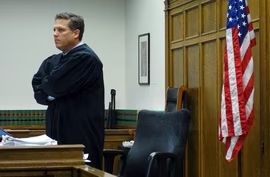
ALI ROGIN: Roger Rogoff, a former Washington state judge and prosecutor, was sworn in last week as U.S.
attorney for the Western District of Washington after a panel of judges in the district unanimously selected him.
Less than an hour later, he was fired via e-mail by a senior Trump administration official.
His was the latest in a series of similar dismissals.
The Justice Department argues his firing is lawful and that the president can remove any court-appointed interim U.S.
attorney.
Rogoff disagrees and has filed a lawsuit to overturn his firing.
He says -- quote -- "The president's actions violate the law and they ignore the protections of the Constitution of the United States."
And Roger Rogoff joins us now.
Thank you so much for being here.
ROGER ROGOFF, Former U.S.
Attorney: My pleasure.
Thanks for having me.
ALI ROGIN: You were sworn in last week and then fired within the hour.
I want to ask, what was going through your mind at the time?
ROGER ROGOFF: Well, it wasn't unexpected.
This had been a long process, and I knew that I was going to be appointed a couple weeks before.
And I know that the judges had reached out to the administration and they were aware as well.
And we tried to reach out to the administration.
So it was not a surprise, given that they had not responded, that that's how it would end up.
ALI ROGIN: You are not the first U.S.
attorney President Trump has fired in this way.
He's not the first president who has fired U.S.
attorneys.
So why file suit?
And what argument are you making?
ROGER ROGOFF: So this is about the rule of law.
This is about ensuring that the constitutional directive for divided government and the constitutional directive for the advice and consent of the Senate and the involvement of Congress is followed vigorously.
That is what this is about.
We want to make sure that someone doesn't continue serving as the head of the U.S.
attorney's office at the Western District of Washington who's not a U.S.
attorney.
He is not the person designated to lead the office, and it should be a U.S.
attorney leading this office.
ALI ROGIN: Right.
He has been doing so on a de facto basis after his temporary appointment to that role expired in February.
So there hasn't been anybody in that job officially since then.
What does it do to cases in the district when there isn't someone officially in charge?
ROGER ROGOFF: Well, I think it puts them in danger.
I think they are subject to motions by criminal defendants.
I think they're subject to motions by civil litigants, saying that indictments, subpoenas, and other documents signed by a purported head of the office are not valid documents.
I also think it creates problems in terms of leadership within the office, morale within the office.
You do not want to have the office led via this chaotic situation.
It hurts those folks who are doing the work every day.
ALI ROGIN: Acting Attorney General Todd Blanche has defended this firing, others like it, saying that this is a presidential prerogative and that there are rogue judges appointing their own choices.
What do you say to that?
ROGER ROGOFF: There are no rogue judges.
The judges in this district followed the law.
They followed the Vacancies Act and did exactly what the act requires them to do, which is, after 120 days with no U.S.
attorney appointed and confirmed, the judges have the right and the duty to put a U.S.
attorney in place until the president does what he's supposed to do, which is get a U.S.
attorney appointed and get them before the Senate, so that they can be confirmed.
Until that happens, we follow the law, and the law says that the judges get to do exactly what the judges did.
ALI ROGIN: I want to ask you about what your role would be in this Department of Justice at this time.
It's been well established that this DOJ maintains its role is to zealously defend the president's agenda and interests.
And the Supreme Court recently affirmed the president's ability and authority to fire any government -- almost any government official at will.
So if you don't agree with the Department of Justice about what your role would entail, why wouldn't the president be justified in firing you?
ROGER ROGOFF: Well, a couple things.
First of all, as I told the judges, as I told the bipartisan commission that pushed me through to be interviewed by the judges, I agree that that's my job is to is to push forward the priorities of this administration, and it's what I promised I would do.
The priorities of this administration are not a mystery, and they're not something that's out in the ether.
They are written down in a memorandum that was put together by A.G.
Pam Bondi in 2025, and they set out, I think, six priorities, none of which are particularly controversial or difficult.
They include focusing on human trafficking.
They include focusing on international drug and gun trafficking organizations.
They focus on criminal immigration cases and a couple of other things, and all of them are reasonable.
And I read that memorandum, and I can certainly put forward the president's priorities and agenda for the U.S.
attorney's office in the Western District of Washington.
So that is not a problem.
The case that you referred to, the Slaughter case, which came down a couple weeks ago, is not the same situation as U.S.
attorney appointments that are at issue here.
There is a clear statutory description of what should happen when there is a vacancy in an office of the U.S.
attorney's office, and we have followed, we the judges have followed that to the letter.
And that Vacancies Act is designed to ensure that congressional involvement, which is part of the Constitution, is respected and that we follow through on that requirement.
ALI ROGIN: Roger Rogoff, thank you so much for sharing your story.
ROGER ROGOFF: Thank you so much.
It's great to be here.
Great to meet you.
GEOFF BENNETT: It has been 250 years since Thomas Jefferson wrote the Declaration of Independence, a document that declared all men equal, even while hundreds of thousands of people remained enslaved.
Judy Woodruff recently traveled to his Virginia home of Monticello to learn more about the third president of the U.S.
and about how his own contradictions reflected the nation's.
It's part of our series Crossroads: America at 250.
JUDY WOODRUFF: Thomas Jefferson's legacy is written all over his beloved Monticello, his home and plantation perched on a mountaintop in Charlottesville, Virginia.
But some of the newest words here aren't his; 610 names are engraved on the 60-foot-long curved memorial wall, one for each of the enslaved people who lived and labored here.
Made out of weathered steel, it opened in 2023.
ANNETTE GORDON-REED, Carl M. Loeb University Professor, Harvard University: This is called a contemplative site.
JUDY WOODRUFF: For generations, their stories were largely absent from the way Americans remember the author of the Declaration of Independence.
What does it say that it took this many years to recognize the lives of these enslaved people?
ANNETTE GORDON-REED: Well, it's the state of the country.
We became interested in the issue of race and slavery in the 20th century as we realized there was a broader story to be told.
JUDY WOODRUFF: That story has been at the center of Annette Gordon-Reed's work for decades.
A professor of law and history at Harvard University, she is one of the country's leading scholars on Jefferson.
She took me on a tour of the home and grounds he designed.
ANNETTE GORDON-REED: So this is all the mind of Thomas Jefferson in this one section here.
JUDY WOODRUFF: And he loved this place.
ANNETTE GORDON-REED: Oh, absolutely.
Yes, he did love this place.
And that's one reason, when we think about giving up slavery, this place ran on slavery.
JUDY WOODRUFF: Over his lifetime, Jefferson enslaved hundreds of people.
How large a contradiction was there between what he wrote in the Declaration, all men are created equal, and how he lived his life?
ANNETTE GORDON-REED: Well, it's a huge contradiction, but it's a contradiction that I think that lots of people lived with.
One of the things that happens when you put things down on paper is that you're held to a particular standard.
But because he created this document that we all look to, we have higher expectations of him, I think, than we do of other people.
JUDY WOODRUFF: Jefferson was also a farmer, violinist, scientist, and an architect who never quite finished work on his own home here.
Throughout his 83-year life, he wrote tens of thousands of letters and documents that helped shape the early United States.
That's one of the things about being a prolific writer and keeping a record.
People can note what you said when you were 20 and know what you said when you were 80, and sometimes they don't go together.
In her latest book, "Jefferson on Race: A Reader," which he edited, Gordon-Reed revisits those writings to ask what they reveal about his views on race, slavery, and the country he helped create.
ANNETTE GORDON-REED: It was not until the 20th century and the civil rights movement that people began in earnest to really question what he said about it.
JUDY WOODRUFF: But she also argues that Jefferson was trying to carefully shape how history would remember him.
You have spent, what, 30 years studying him.
What new were you able to learn from all of this?
ANNETTE GORDON-REED: We focused on the way that Jefferson fell short and was conservative in ways.
But I think the letters show and the documents show that this is a person working in a very, very complicated situation.
He wants to be remembered for the revolution and for the University of Virginia and the statute of religious freedoms.
Those are things that are progressive, creating a university that didn't have a chapel at the center, but had a library at the center of it, championing religious freedom.
That was a progressive kind of thing, and the Declaration of Independence, helping to create a nation that was a republic in a world that was mainly monarchies.
JUDY WOODRUFF: But these writings also revealed deeply racist beliefs.
ANNETTE GORDON-REED: The interesting thing about putting these letters together and these documents together is to see how people live white supremacy, how they live race in the country.
He has particular views about race, particular views about African American people.
In the "Notes on the State of Virginia," for example, he says that he never saw a Black person utter anything beyond plain narration, in other words, telling a story.
He's basically saying they couldn't reason.
And yet, at Monticello, he asked people to do things all the time that required reason.
And in some of these letters, he talks about individual people as intelligent and capable of doing things.
JUDY WOODRUFF: But perhaps no part of Jefferson's life has forced a greater reckoning than his relationship with the enslaved Hemings family.
ANNETTE GORDON-REED: Sally Hemings and her siblings, five of her siblings, had the same father as Martha.
JUDY WOODRUFF: As many as 70 members of the Hemings family were enslaved at Monticello over the course of five generations.
After his wife, Martha, died, Jefferson began a decades-long relationship with Sally Hemings, an enslaved woman who was also the half-sister of his wife.
Together, they had six children.
ANNETTE GORDON-REED: They weren't seen as important.
You change the whole story when you identify, you give the person a name and you give them a context.
This isn't just a 14-year-old manservant.
This is his wife's half-brother.
And so we don't know how they dealt with each other, but immediately the reader can think, well, what was that like?
How did they do that?
JUDY WOODRUFF: Of the more than 600 people Jefferson owned, he freed only 10.
Most were members of the Hemings family.
What was holding him back?
ANNETTE GORDON-REED: Well, the question of race.
He lived in a community that was suffused with these ideas.
And it's not just about an individual who has bad thoughts about race.
It's a community that has values that promote these kinds of things.
JUDY WOODRUFF: Despite Jefferson never giving up the system of enslavement that sustained his way of life, Gordon-Reed resists reducing him to a single dimension.
ANNETTE GORDON-REED: He thought he had done a lot.
Jefferson was obsessed with the revolution and the United States of America, the creation of the United States of America.
It was a big deal to create a new country.
And I think his record shows that we have expectations of him that could never have been fulfilled.
He was on Earth to do the things that he did.
And the things that I want him to do or I would have wanted him to do, he wasn't.
JUDY WOODRUFF: Given everything we know, should he be more honored, or do the negatives outweigh the positives?
ANNETTE GORDON-REED: I don't think the negatives outweigh the positives.
I think we're sitting in a country that he helped to found, and so many aspects of the country have moved forward because of the words that he decided to put in the Declaration.
It could have been written in a completely different way.
But to have those words about equality and the pursuit of happiness, those things have been enormously useful to all Americans.
JUDY WOODRUFF: Have your own views on this evolved over time?
ANNETTE GORDON-REED: Yes, I think maybe it's because I'm getting older, but I am less, I would say, negative about Jefferson.
I see how hard it is to do anything in the world.
And the fact that he did a lot is impressive to me.
And I think it's as much about me and my growth and my understanding about how to grapple with these kinds of contradictions.
It's been a learning experience for me.
JUDY WOODRUFF: For Gordon-Reed, the question isn't whether Jefferson was a hero or a villain.
It's what Americans do with a founder whose ideals reached farther than he did.
You have said that understanding Thomas Jefferson calls on -- in a way, calls on all of us to think about, are we living up to our ideals at this moment?
What did you mean by that?
ANNETTE GORDON-REED: In looking at him and seeing flaws and the good parts and the bad parts, we -- and also the optimism that he had about the country, we have to look to ourselves to decide, are we up to this, this notion of keeping a republic?
And are -- do we really value the idea of science?
Do we really value the idea of a multicultural society in a place that is -- has been from the very beginning full of all different types of cultures and religions, religious diversity?
That's always been a part of America.
But do we value that?
And it's not clear to me that many of our fellow Americans actually do.
So I think it's an opportunity for us to search as we approach the 250th anniversary, do we want to go forward with all of this, this American experiment that he thought was something new under the sun?
He said, we can now say that there's something new under the sun, and he thought that was the United States.
And the question is, do we believe that?
JUDY WOODRUFF: For the "PBS News Hour," I'm Judy Woodruff in Charlottesville, Virginia.
AMNA NAWAZ: Alcohol consumption is linked to adverse health effects, including cancer, heart and liver disease, and addiction.
And there are an estimated 500 alcohol-related deaths in the U.S.
every day.
GEOFF BENNETT: On the latest episode of "Horizons," William Brangham and his guests discuss alcohol as a public health concern.
WILLIAM BRANGHAM: Anyone that has either traveled to Europe or any of our European viewers will know that, if you buy a pack of cigarettes in Europe, they come with these gruesome images that show throat cancer, tongue cancer, mouth cancer.
Like, you cannot escape purchasing a pack of cigarettes without a glaring demonstration of what this product could do to you.
Do you think we should find some way to put a warning label on alcohol, maybe not that gruesome, but do you think that that's a good idea, Priscilla?
PRISCILLA MARTINEZ, Alcohol Research Group: I think warning labels are a very good idea.
The surgeon general came out in January with the U.S.
Advisory on Alcohol and Cancer, and that called for warning labels to be updated to include cancer warnings, most specifically about breast cancer and colon cancer.
And warning labels are known to raise awareness of a certain behavior's health effects.
And you brought up the classic example of tobacco.
So I think warning labels would go far.
Even in California, we have Proposition 65, which requires point of sale to have a sign about various carcinogens, and alcohol is one of them, and so you see it at alcohol outlets, not always in the most obvious places, but they are there.
And so you have higher levels of awareness that alcohol is a carcinogen in California relative to other states.
We have seen that in some surveys.
So, yes, I think warning labels would be a very good idea.
The challenge is that it is literally an act of Congress and would require immense political will.
WILLIAM BRANGHAM: Yes.
Lev, in your reporting, one of the things I know you touched on is the difficulty that doctors have to talk about this, because they would be an obvious natural conduit to talk to their patients.
Talk a little bit about that, the difficulty that the medical community has in communicating what is -- seems so evident.
LEV FACHER, STAT News: There are two problems really.
One is that many doctors are not particularly comfortable asking their patients about their alcohol consumption.
A lot of people are probably familiar with the experience of going in for a checkup for a physical.
Your doctor asks you about your drinking, and you say something like, oh, a couple a week, or I drink socially, and that's the end of the conversation.
And even if your answer is ambiguous, even if there's really a wide range of potential behavior that your answer could imply, the doctor is likely to just move on.
And there are a couple of reasons for that.
One, it's just uncomfortable.
Another, there's some training about alcohol and addiction medicine in general in medical school, but I think there's not enough.
But the other side of this problem is that, even if a doctor were to implement the screening tools that we have -- and there are a number of tools and surveys that are helpful in determining someone's drinking level and whether it's harmful.
Even if a doctor were to have that conversation in a productive way, there aren't necessarily amazing resources to give people, especially if they exist somewhere along the spectrum that we have been talking about, where you want to reduce your drinking, but you're not a candidate for an inpatient rehab program, you're not interested in Alcoholics Anonymous, you're not someone who wants or necessarily even needs to reduce your drinking to zero.
So there are two problems.
There's the information intake and whether doctors are good at that and willing to participate.
But then, even if they did, do we as a country have the infrastructure to help people moderate and to help get people with more serious, more harmful drinking behavior into some type of treatment program that would be helpful to them?
AMNA NAWAZ: And you can watch "Horizons" any time on our YouTube page and every weekend on PBS.
Check your local listings.
And, remember, there's always a lot more online, including a look at the recent rise in student loan scams and how to protect yourself against them.
That is at PBS.org/NewsHour.
GEOFF BENNETT: And that's the "News Hour" for tonight.
I'm Geoff Bennett.
AMNA NAWAZ: I'm Amna Nawaz.
On behalf of the entire "News Hour" team, thank you for joining us.

China's latest AI model threatens U.S. lead in tech race
Video has Closed Captions
Breakthroughs in Chinese AI models threaten U.S. lead in tech race (6m 24s)
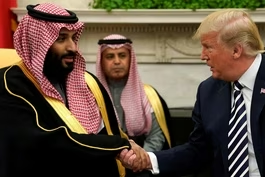
Critics say U.S.-Saudi nuclear deal could fuel proliferation
Video has Closed Captions
Critics warn U.S. nuclear power deal with Saudi Arabia could fuel proliferation (9m 11s)
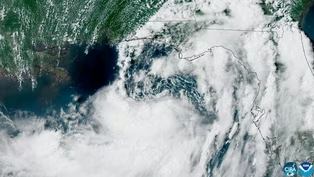
News Wrap: Tropical Storm Bertha makes landfall in Louisiana
Video has Closed Captions
News Wrap: Tropical Storm Bertha makes landfall in Louisiana (6m 52s)
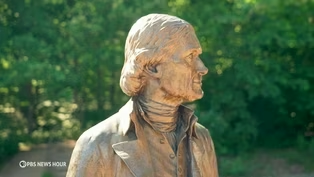
Thomas Jefferson's complicated legacy
Video has Closed Captions
Thomas Jefferson's complicated legacy 250 years after the Declaration of Independence (9m 35s)
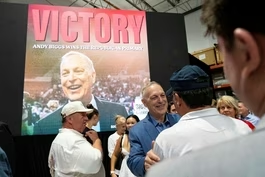
Trump loyalists, election deniers win Arizona GOP primaries
Video has Closed Captions
The implications of Trump loyalists and election deniers winning GOP primaries (6m 13s)
Trump threatens strikes on Iranian bridges and power plants
Video has Closed Captions
Trump escalates threats, vows to target Iranian bridges and power plants (3m 25s)
U.S. attorney fired by Trump sues to overturn dismissal
Video has Closed Captions
'This is about the rule of law': U.S. attorney fired by Trump sues to overturn dismissal (6m 46s)
Providing Support for PBS.org
Learn Moreabout PBS online sponsorship New Episode
- News and Public Affairs

Today's top journalists discuss Washington's current political events and public affairs.

- News and Public Affairs

FRONTLINE is investigative journalism that questions, explains and changes our world.


 New Episode
 New Episode
 New Episode
 New Episode
 New Episode
 New Episode

Support for PBS provided by:
Major corporate funding for the PBS News Hour is provided by BDO, BNSF, Consumer Cellular, American Cruise Lines, and Raymond James. Funding for the PBS NewsHour Weekend is provided by...