
April 22, 2026 - PBS News Hour full episode
4/22/2026 | 57m 46sVideo has Closed Captions
April 22, 2026 - PBS News Hour full episode
April 22, 2026 - PBS News Hour full episode
Problems playing video? | Closed Captioning Feedback
Problems playing video? | Closed Captioning Feedback
Major corporate funding for the PBS News Hour is provided by BDO, BNSF, Consumer Cellular, American Cruise Lines, and Raymond James. Funding for the PBS NewsHour Weekend is provided by...
April 22, 2026 - PBS News Hour full episode
4/22/2026 | 57m 46sVideo has Closed Captions
April 22, 2026 - PBS News Hour full episode
Problems playing video? | Closed Captioning Feedback
How to Watch PBS News Hour
PBS News Hour is available to stream on pbs.org and the free PBS App, available on iPhone, Apple TV, Android TV, Android smartphones, Amazon Fire TV, Amazon Fire Tablet, Roku, Samsung Smart TV, and Vizio.
Providing Support for PBS.org
Learn Moreabout PBS online sponsorshipAMNA NAWAZ: Good evening.
I'm Amna Nawaz.
GEOFF BENNETT: And I'm Geoff Bennett.
On the "News Hour" tonight: Iran attacks multiple ships near the Strait of Hormuz, complicating efforts to end the war and reopen the crucial shipping lane.
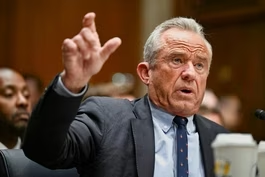
AMNA NAWAZ: On Capitol Hill, Health Secretary Robert F. Kennedy Jr.
defends his controversial changes, including to vaccine recommendations.
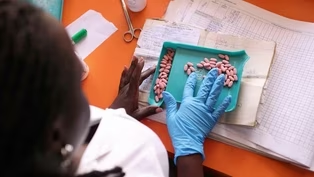
GEOFF BENNETT: And we report from Uganda on the spike in disease-related deaths after the Trump administration slashed aid to countries around the world.
DR.
OTIM PIUS, Medical Officer, Mukono Church of Uganda Hospital: It is very painful to lose someone of a treatable disease.
(BREAK) GEOFF BENNETT: Welcome to the "News Hour."
Iranian forces attacked and seized at least two ships in the contested Strait of Hormuz today as a standoff over when or whether to return to negotiations continued.
AMNA NAWAZ: The Trump administration said it did not consider the attacks violations of a cease-fire that President Trump extended last night at the urging of Pakistani mediators.
Our White House correspondent, Liz Landers, continues to follow this all and joins us now.
So, Liz, we have not heard from the president himself on Iran today, but the White House press secretary did take some questions.
What did she say?
LIZ LANDERS: Karoline Leavitt did an interview on FOX News and then also spoke to reporters outside of the West Wing this afternoon.
She said that the president is satisfied with the blockade.
Here's more from those comments a few moments ago.
KAROLINE LEAVITT, White House Press Secretary: I'm not going to set a timetable for the president.
He has not done that, and I won't.
I know there's been some anonymous sourced reporting that there was maybe a three-to-five-day deadline.
That is not true.
The president has not set a deadline himself.
Ultimately, he will dictate the timetable.
And, again, he is satisfied with the naval blockade.
And he understands that Iran is in a very weak position and the cards are in President Trump's hands right now.
LIZ LANDERS: Leavitt said that the United States has been clear in its demands and red lines right now.
One of those we know, Amna, is that Iran must agree to turn over their enriched uranium before -- as part of these negotiations.
The president has said that in the past.
She was also asked about the timeline of this conflict.
We are past what the president said how long this would take.
She said that it's basically up for him to decide.
She would not put a timetable on how much longer this may last.
AMNA NAWAZ: She alluded to there don't seem to be firm plans for when there will be more direct negotiations with the Iranians.
What do we know about where that stands?
LIZ LANDERS: The White House is trying to project strength right now, but things are really at a standstill after yesterday's talks were called off.
The vice president, of course, did not travel to Pakistan.
Today, as we mentioned at the top, Iran fired upon two ships in the Strait of Hormuz.
We have not heard from the president about this, which I think is notable.
And the U.S.
does not think that firing on those boats is a violation of the cease-fire because they were not U.S.
or Israeli boats.
That is what Leavitt said.
The U.S., though, has attacked Iranian-flagged ships in the last few days.
We have covered that.
And within the last few minutes, Reuters has reported that the U.S.
military has intercepted three Iranian ships in Asian waters today, so more action on this happening outside of the strait and outside of the region too.
The Iranian president posted on X today.
He said that the breach right now of commitments, blockade and threats are hindering these negotiations.
He also said that the U.S.
is engaging in -- quote -- "endless hypocritical rhetoric and contradiction between claims and actions."
We know that the president told The New York Post earlier today that there may be these negotiations that get back on track within the next few days, by Friday, he said.
But another regional diplomat that I had spoken to yesterday about this said that it continues to be an issue that the Iranians do not have a clear leadership and clear leader here in these talks.
AMNA NAWAZ: White House correspondent Liz Landers beginning our coverage.
Liz, thank you.
GEOFF BENNETT: Well, traffic through the Strait of Hormuz has come to a virtual standstill since the U.S.
and Israel attacked Iran almost two months ago.
Around 20 percent of the world's petrochemical supply normally moves through the strait.
As tanker traffic drops sharply and attacks on oil and gas facilities continue, the ripple effects are growing by the day.
For more on the impact, return now to Karen Young.
She is a senior research scholar at the Columbia University Center on Global Energy Policy and her senior fellow at the Middle East Institute.
Karen Young, thank you for being with us.
KAREN YOUNG, Middle East Institute: Thank you.
GEOFF BENNETT: I know you told our team about 600 million barrels of oil haven't reached their expected destinations since the end of February.
How does that figure compare to previous oil supply disruptions like the 1973 oil embargo or even the 1990 Gulf War?
KAREN YOUNG: This is the largest supply shock to energy markets that we have ever experienced.
So there really is no comparison.
And even to the COVID pandemic, when we had such a sharp contraction in demand, this is not the same, right?
Because we still need this oil.
We're expecting it and it's not -- the deliveries are now not happening.
So the ships that were on their way at the end of February have basically arrived to their destinations, and there are not resupplies coming.
So the longer that the blockade and the threat of violence within the strait continues, we sort of deepen this deficit of oil supply that is going to countries and destinations around the world.
GEOFF BENNETT: Beyond this deficit, as you put it, of oil and jet fuel, what's your timeline for when consumers in the U.S.
and Europe will feel the impact on things like grocery prices and consumer goods?
KAREN YOUNG: Well, we're already feeling it, but the geographic impacts, it has been varied.
And we have already seen really sharp contractions in Asia and East Asia and particularly in countries that don't have large stockpiles or governments that don't have the financing to subsidize the increased price of fuels.
Those countries are experiencing basically shortages and efforts to control demand, so telling people not to go to work, not to drive on certain days, to basically diminish their energy demand.
That's not happened in Europe or North America or South America yet, but the way that we're going to experience this, of course, is first in our transit prices of gasoline, refined products.
We're already seeing airlines, particularly airlines that serve Europe, canceling flights for the summer, in anticipation of a shortage of jet fuel.
So, as you said, yes, there -- about normal traffic through the Strait of Hormuz would be about 20 million barrels per day of oil and about five million, four to five million barrels per day of refined product.
That refined product is jet fuel, diesel, and other kinds of fuels and fuel materials like naphtha.
And so it's about transportation, but it's also about the kinds of things that are made from oil.
So, petrochemicals, you mentioned.
So anything that's about packaging, plastics, medical devices, tires, all of those things are not going to be produced at the same volumes or at the same prices.
And that's when consumers are going to start to feel the pinch and we're going to start to see some inflationary pressures.
GEOFF BENNETT: Does this crisis accelerate any permanent shifts in global energy supply chains?
Or, in your view, once the strait reopens, whenever that is, everything sort of snaps back to the way it was?
KAREN YOUNG: We can't just snap back.
And so I think that's a really important thing for people and consumers and businesses to understand.
It's going to take some time.
And the reason why is that first you have to have safe transit of ships to come into the Gulf and load.
They have to get to loading facilities in Kuwait and Iraq, which essentially have been just shut in.
And so first what will happen is that ships will arrive and they will be filled from oil that's been put into storage.
So you're not even going to see the restarting of oil wells and pumping until that storage is emptied.
Then you can start to reignite the pumping stations of these wells.
And that's not a switch process.
Some of them will take longer.
They will require a little bit more technical work.
Shaikh Nawaf of the Kuwait Petroleum Corporation, a corporation, has said this could take three to four months in Kuwait.
And so then you're going to be able to start your refining processes and get that jet fuel, the diesel products moving as well.
But what we know in terms of the ability to get to an agreement is that this could take some time, especially if the waters are unsafe, if they're mined, if ships require military support.
It will be a prolonged period of instability.
GEOFF BENNETT: Karen Young, senior fellow at the Middle East Institute, thank you for joining us this evening.
KAREN YOUNG: Thank you.
GEOFF BENNETT: In the day's other headlines: National Democrats are celebrating a win in Virginia after voters there narrowly approved to plan to redraw the state's congressional map in a way that could help them pick up four seats in this year's midterm elections.
Virginia is currently represented by six Democrats and five Republicans in the House, a near-even split.
The new map, drawn by Democrats, would leave just one clearly Republican district.
House Democratic Leader Hakeem Jeffries defended the new plan this morning as a counterpunch to similar redistricting efforts in Republican-led states.
REP.
HAKEEM JEFFRIES (D-NY): Donald Trump and Republicans launched this gerrymandering war.
And we have made clear as Democrats that we're going to finish it.
GEOFF BENNETT: Republicans have challenged the map and the state's Supreme Court will ultimately weigh in on whether the redistricting plan is illegal.
The U.S.
Supreme Court found that an Army veteran who was injured by a suicide bomb in Afghanistan 10 years ago can sue the government contractor that hired the attacker.
Former Army Specialist Winston Hencely was wounded when an Afghan employee blew himself up at Bagram Airfield in 2016, killing five people.
Today's decision overturns a lower court ruling that had blocked his lawsuit due to a federal government protection during wartime.
In a rare lineup, the court's liberal three justices, Ketanji Brown Jackson, Sonia Sotomayor, and Elena Kagan joined conservative Clarence Thomas in the decision to stop the war.
The Trump administration is reportedly in talks to send hundreds of Afghans who worked with U.S.
forces to the Democratic Republic of Congo, rather than bring them to the U.S., as promised.
That's according to an advocacy group that says it's been briefed by U.S.
officials.
These Afghans have been stuck for more than a year on a former U.S.
Army base in Qatar after their visa processing was effectively halted.
On a press call today, a retired U.S.
Marine originally from Afghanistan called the idea of sending them to Congo political theater.
GUNNERY SGT.
SEAN JAMSHIDI (RET.
), U.S.
Marine Corps: The Department of State advises American citizens to reconsider travel to the DRC and many areas listed as do not travel due to violent crime, civil unrest and armed conflict.
We're telling American allies, people who stood with us, who were vetted, who supported our mission to go somewhere the United States government itself warns Americans not to go to?
GEOFF BENNETT: A State Department spokesperson says the U.S.
remains committed to pursuing -- quote -- "voluntary resettlement options," but did not provide further details.
In the Southeastern U.S., wildfires are intensifying as strong winds and low humidity fan the flames.
Firefighters in Florida are battling more than 100 blazes across that state, which is suffering one of its worst fire seasons in decades, while, in Georgia, officials in one county say nearly 50 homes have already been destroyed and hundreds more are at risk.
Governor Brian Kemp has declared a state of emergency for the affected areas.
Speaking to reporters today, local officials along Georgia's coast urged residents to stay safe.
CHUCK WHITE, Emergency Management, Camden County, Georgia: This is very dynamic, very fluid, so it's moving and the threat moves with it.
We have one singular overarching priority.
And that is life, safety for first the public and secondly for those that are going into harm's way as our first responders to fight the fire.
GEOFF BENNETT: Meantime, in West Virginia, authorities say a chemical leak at a refinery killed two people today and sent at least 19 others to the hospital.
A local official says workers were preparing to shut down at least part of the facility when the leak occurred, causing a chemical reaction.
The plant is located about 10 miles west of Charleston.
A new report out today highlights the troubling state of the nation's air quality.
According to a study from the American Lung Association, more than 150 million people live in areas affected by harmful levels of pollution.
That's about one in four Americans.
That includes roughly 33 million children who live in areas that failed at least one measure of air pollution.
More than seven million of those live in a community that failed all air quality measures.
According to the report, four of the five most polluted cities are in California, with the Los Angeles and Long Beach area topping the list.
Separately, school officials in Los Angeles are cracking down on screen time for students.
It's the first major school district in the nation to set limits on the use of laptops and tablets in class.
The measure calls for guidelines for each grade and subject and bars students in first grade or younger from using devices, among other measures.
It's a sharp turn from the COVID era, when schools leaned into the use of technology.
That led to pushback from parents and teachers, who said it led to unhealthy screen habits.
The district is the second largest in the nation, serving about half-a-million students.
On Wall Street today, stocks climbed higher despite ongoing concerns over the Iran war and oil prices.
The Dow Jones industrial average gained 340 points on the day.
The Nasdaq jumped nearly 400 points, or more than 1.5 percent.
The S&P 500 notched its latest all-time high.
And Dave Mason, who co-founded the psychedelic British band Traffic, has died.
Seen here on the left, Mason wrote some of the group's biggest songs, including the rock classic "Feelin' Alright?"
Joe Cocker's rendition soared on the global charts.
Mason also had a successful solo career with hits like "We Just Disagree."
And he worked with the likes of Jimi Hendrix and the Rolling Stones and was inducted into the Rock and Roll Hall of Fame back in 2004.
Mason's traffic bandmate Steve Winwood said today that he helped create music that continues to mean so much to listeners around the world.
Steve Winwood Dave Mason was 79 years old.
And Congressman David Scott has died.
The Democrat from Georgia is the former chairman of the House Agriculture Committee and a leading voice in his party for farm aid policies.
Scott was seeking a 13th term in Congress despite concerns over his declining health.
House Democratic Leader Hakeem Jeffries called the lawmaker a trailblazer today.
David Scott was 80 years old.
Still to come on the "News Hour": the death of two Americans in Mexico raises questions about U.S.
operations against drug cartels; concerns over political election interference grow ahead of the midterm elections; and the head of the National Park Foundation on how best to preserve the nation's beloved shared spaces.
AMNA NAWAZ: Health Secretary Robert F. Kennedy Jr.
was back on Capitol Hill today, this time testifying before senators for his sixth and seventh public hearing since last week.
These hearings mark his first time back before lawmakers in months, giving members a chance to press him on some of the biggest changes he's making on spending cuts, vaccines, and other public health issues.
Lisa Desjardins has been covering those hearings and filed this report.
MAN: The committee will come to order.
LISA DESJARDINS: Today, HHS Secretary RFK Jr.
reached the finish line in a marathon of hearings about his agency's budget and proposed cuts to it.
ROBERT F. KENNEDY JR., U.S.
Health and Human Services Secretary: We are cutting red tape, speeding the decisions and demanding transparency.
We're also cracking down on waste, fraud and abuse.
LISA DESJARDINS: President Trump's budget proposal calls for a 12 percent cut, billions of dollars to the National Institutes of Health, and cuts to programs that support mental health, women's health, HIV/AIDS prevention and more.
But senators raised a full array of topics.
SEN.
MICHAEL BENNET (D-CO): Do you realize that, last year, the United States had the highest number of measles cases in 30 years?
LISA DESJARDINS: Under Secretary Kennedy, the U.S.
is facing the worst measles outbreak it's seen in decades, over 2,000 cases last year, as the country has seen a drop in vaccination rates for kids.
While some Republicans applauded Kennedy's handling of the outbreak... SEN.
TIM SCOTT (R-SC): We would not be on the right side of this outbreak without your leadership.
LISA DESJARDINS: ... Democrats pointed to his past comments questioning vaccines and his move last year to reconstruct the HHS vaccine advisory panel, adding several members who are vaccine skeptics.
SEN.
RON WYDEN (D-OR): Why would you be doing something that is so awful for kids on this vaccine issue?
ROBERT F. KENNEDY JR.
: Senator, we under my leadership handled the measles outbreak better than any country in the world.
This is a global outbreak.
LISA DESJARDINS: In the days' second hearing, Republican Bill Cassidy, a doctor himself, followed up on a previous question which Kennedy did not answer yesterday about Trump's nominee to direct the CDC, Dr.
Erica Schwartz.
She supports immunizations.
SEN.
BILL CASSIDY (R-LA): Will the new director, whoever she is, have the right to make decisions independently of those political appointees and/or replace them or otherwise reassign them, so they cannot continue to actively undermine trust in immunizations?
ROBERT F. KENNEDY JR.
: Your characterization of the political appointees is wrong.
And the CDC director has that power.
LISA DESJARDINS: Kennedy's past words came up a few times, including these comments he made in a 2024 podcast suggesting something called wellness farms.
ROBERT F. KENNEDY JR.
: Every Black kid is now just standard put on Adderall, SSRIs, benzos, which are known to cause -- induce violence.
And those kids are going to have a chance to go somewhere and get re-parented, to live in a community, where there will be no cell phones, no screens.
LISA DESJARDINS: But in a House hearing last week, he denied saying that.
REP.
TERRI SEWELL (D-AL): You were suggesting that the federal government should take Black children away from their families and re-parent them and send them off to some wellness farm, instead of providing them with evidence-based... ROBERT F. KENNEDY JR.
: You're just making stuff up.
REP.
TERRI SEWELL: I am absolutely not making this up.
LISA DESJARDINS: Kennedy today apologized for the remarks, but maintained that he doesn't remember making them.
Throughout, Republicans praised Kennedy for out-of-the-box thinking and his work on everything from drugs for PTSD to nutrition.
SEN.
MIKE CRAPO (R-ID): I believe that your effort and focus on making America healthy again and helping us to focus on nutrition and prevention and healthy lifestyles is one of the most significant things that you have done.
LISA DESJARDINS: The hearing's a reminder of how much Kennedy oversees, from Medicaid and Medicare to the FDA,and how much of American life he touches.
For more on Health Secretary Kennedy, what he is prioritizing and the continuing questions around much of his agenda, I'm joined now by Dr.
Deb Houry.
She served as the chief medical officer for the Centers for Disease Control and Prevention until she resigned in protest at the firing of CDC Director Susan Monarez last year.
Dr.
Houry, I want to get your reaction to these hearings.
And among the things that we know going into it were there were multiple supports suggesting that the White House had pressured RFK to publicly say less about vaccines.
From what you heard in these hearings, do you think his position has changed on vaccines or how do you understand it?
DR.
DEB HOURY, Former CDC Chief Medical Officer: Not at all.
He was very clear.
He didn't know information about the hepatitis B vaccine, how long it had been safety-tested for.
He spoke incorrectly about that.
He didn't even understand how babies get hepatitis B. He said only from moms.
He also -- when he talked about measles, he said, no, the child could have died from it.
And then he also said that healthy people don't usually die from infections.
But I think having 130 pediatric flu deaths that were unvaccinated, I beg to differ.
LISA DESJARDINS: Now, Kennedy did say repeatedly during these hearings that he believes vaccines save lives, that he wants them to save lives.
He says he questions if they have all been vetted, essentially.
I wonder, do you think his policies back that up, this idea of vaccines as lifesaving?
I know that sounds like a weighted question, but it's an important one.
DR.
DEB HOURY: He really cherry-picks, like, data and studies.
To Senator Cassidy, he presented this one study, and he talked about how it was really sanitation that saved lives and not vaccines.
I looked at the paper.
And, at the end of the paper, it says vaccines significantly contributed to the decline in diseases.
And, actually, there were still several hundred deaths from measles before vaccines were introduced that then, when vaccines came into play, those deaths went to zero.
So, the secretary presents things to fit his agenda versus actually using data and science to drive decisions.
LISA DESJARDINS: That was an interesting discussion about what changed in the 20th century in terms of public health.
LISA DESJARDINS: But I want to ask about someone now in the 21st century who could be a really important lieutenant for Secretary Kennedy.
and of course, is Dr.
Erica Schwartz.
She's publicly supported vaccinations and immunizations.
But you have been concerned that she could be ousted or overruled.
Today, as we heard, Secretary Kennedy said, no, she will have independent authority.
Did that give you any reassurance?
DR.
DEB HOURY: Well, today, he said she'd have independent authority to get rid of the CDC political appointees who've been undermining vaccines.
But, earlier this week, he said that he wouldn't necessarily sign off on her vaccine recommendations.
And I thought that was one of the few truthful things the secretary has said.
LISA DESJARDINS: Does her nomination itself make you think the Trump administration wants to go a different direction from the secretary?
DR.
DEB HOURY: Potentially.
But what concerns me is, the secretary is still who the CDC director reports to.
And when you look at the vaccine committee that the CDC director gets advisory information from, the charter was updated last week and it changed it from expertise to just knowledge.
And the secretary is still asking for information around vaccine safety and still misspeaking about vaccines.
So I think it's really window dressing at this time.
LISA DESJARDINS: Kennedy indicated he is investing in some health priorities, including Alzheimer's.
But, obviously, there have been cuts in many areas under him.
Senator Collins raised some reporting yesterday that indicates grants with the word women in them have been cut by some 31 percent.
I want to ask you, where do you see cuts in NIH and research right now?
DR.
DEB HOURY: I think it's really confusing when you look at the congressional budget versus the president's budget, as well as the secretary's leadership.
Programs like smoking and reproductive health and oral health, violence prevention, drowning are all in the congressional budget.
But they're not in the president's budget, and all those staff are gone from CDC.So it's unclear how these lifesaving programs are going to be implemented, when there's no people to do it.
LISA DESJARDINS: Dr.
Deb Houry, we will continue following this along with you.
And we really appreciate your time.
Thank you.
DR.
DEB HOURY: Thank you.
AMNA NAWAZ: An investigation is under way after four officials, including two Americans, were killed in a car crash in Mexico.
It happened in the state of Chihuahua just south of the U.S.-Mexico border.
It's being called an accident by the local government, but happened after a special operation to destroy drug labs in a mountainous part of the state.
It's been widely reported that the two Americans were CIA officers.
Now the search for answers, including from Mexico's president, Claudia Sheinbaum, who says the Mexico federal government was not aware that U.S.
officials would be involved in the operation.
CLAUDIA SHEINBAUM, Mexican President (through translator): This has to be clarified.
The Foreign Ministry sent a letter to the U.S.
ambassador requesting that all information be provided, saying that this is not a part of the security protocol we have agreed upon, nor the understanding we have with them, and asking that all information be provided.
It is an issue of national security and sovereignty, so what is happening is not a minor matter.
AMNA NAWAZ: For perspective on this, we're joined now by John Feeley, a former U.S.
ambassador to Panama with a lengthy diplomatic career in Latin America.
He's now chief executive of the Center for Media Integrity of the Americas.
Good to see you.
Thanks for being here.
JOHN FEELEY, Former U.S.
Ambassador to Panama: It's a real pleasure.
AMNA NAWAZ: So, before we get to what President Sheinbaum said there, the circumstances of the deaths here remain a little bit unclear, but why would U.S.
officials, and, in particular, CIA officials, be involved in an operation like this?
Is that unusual?
JOHN FEELEY: First of all, I can't confirm they were CIA officials.
But I was the deputy chief of mission in Mexico as far back as 2009.
The United States and Mexico have always collaborated.
That collaboration goes up and down, and there are peaks and valleys, usually driven by politics.
But you have to understand, Amna, that the training and expertise that United States agencies, whether it's in the CIA, the DEA, HSI, DHS, it is not all in stuff that can be transmitted in a classroom.
There's a lot of in-the-field work that's done.
But the important point, and I believe it's the point here, is that it's always done in coordination with the Mexicans.
It is never done unilaterally.
AMNA NAWAZ: I want to point out President Sheinbaum has consistently resisted pressure from the Trump administration to deploy U.S.
forces to try to counter some of these drug cartels.
She's saying American boots on the ground would violate Mexico's sovereignty.
What do you make of the way she is reacting to this news?
To these deaths, and also what did you see on the ground?
You have just come from Mexico yourself.
JOHN FEELEY: Exactly.
And I think there's a really clear dichotomy between what you're seeing.
What President Sheinbaum is undeniably reacting to is the Mexican political class' long-held suspicion that the United States is always going to violate Mexico's sovereignty, that they're going to do something behind their back.
I used to call it the syndrome of the ambush.
They always thought, yes, the Americans are here, but they're going to do something unilateral.
And, on the other side, the Americans always show up and say, which one of these guys is corrupt?
In this case, she feels that she has to respond to those prickly concerns about sovereignty.
But I got to tell you, I was just there.
I don't see it reflected in the population, which wants the Mexicans and the Americans to collaborate on the organized crime problem.
AMNA NAWAZ: You don't worry that this could lead to further mistrust, this news of CIA potentially officials being involved in this, this could somehow hamper joint operations in the future?
JOHN FEELEY: Well, let's be honest.
I think President Trump's intemperate rhetoric, to put it very diplomatically, has done more to hurt the cause.
I think one of the things you see going on here is that there is excellent cooperation at the operational level.
There is dysfunctional political rhetoric at times, and it clouds it.
So my hope is that there will be an understanding by both sides at a political level that the American people and the Mexican people want this kind of collaboration to go on.
AMNA NAWAZ: What about from the cartels?
I mean, when the drug lord El Mencho was killed earlier this year, that set off a firestorm of violence.
Do you worry we could see a similar wave of violence as a result of this operation?
JOHN FEELEY: Amna, violence in Mexico related to the cartels is always episodic.
It goes up, it goes down.
It moves from plaza to plaza, meaning region to region, wherever the cartels are fighting one another, or the government comes in to fight the cartels.
I think that until Mexico and the United States are able to genuinely collaborate, to manage, nobody solves the drug problem, but to manage the organized crime, the guns flowing from north to south, you're going to see continuing violence.
AMNA NAWAZ: About a minute or so left, but I want to ask you to step back and tell me how you look at Claudia Sheinbaum and her leadership, the way that she has navigated the relationship with President Trump between two nations in which tensions can sometimes flare.
How do you look at it?
JOHN FEELEY: Well, the first thing you have to keep in mind is that she's significantly popular in her own country.
That's something every president looks for.
I think she's very cagey.
I think she's very astute.
I think that being somebody who is trained as a scientist, who speaks very good English, I think she kind of took the measure of Donald Trump early, realized that this was somebody who was asymmetrically far more powerful than she is, or her government is, and figured I'm going to just do what I need to do to keep both my domestic concerns onside and him onside.
And she's been clear, unilateral attacks into Mexico are a red line and would shut down the communication.
AMNA NAWAZ: Former U.S.
Ambassador to Panama John Feeley, always great to have you here.
Thank you so much.
JOHN FEELEY: Great to be with you, Amna.
GEOFF BENNETT: Soon after taking office 15 months ago, the Trump administration dismantled the $40 billion U.S.
Agency for International Development.
Days later, Secretary of State Marco Rubio issued an exemption for what he described as lifesaving humanitarian assistance.
But what that exemption covered was never clearly defined, and, in practice, funding for health programs has been sharply reduced.
Our Fred de Sam Lazaro begins a two-part report from the East African nation of Uganda.
FRED DE SAM LAZARO: It's near the start of another day for Dr.
Otim Pius in the HIV clinic of McConnell hospital.
DR.
OTIM PIUS, Medical Officer, Mukono Church of Uganda Hospital: We used to have about four doctors working in the clinic, but, right now, I am alone.
We have about 3,200 patients.
It is impossible for me to see all of them.
FRED DE SAM LAZARO: His patients are among millions across Africa who have received treatment and lifesaving antiretroviral drugs for HIV under PEPFAR, a program begun in 2003 by the George W. Bush administration.
It all ground to an abrupt halt at the start of the second Trump administration.
It shut down USAID and issued a stop-work order across all aid programs.
Dr.
Pius says HIV incidents and mortality rates more than doubled.
DR.
OTIM PIUS: For both HIV and also HIV-associated illnesses, like T.B., like meningitis, close to 15 percent of the clients dying of malaria and T.B.
It is very painful to lose someone of a treatable disease.
FRED DE SAM LAZARO: The numbers began to trend downward, closer to 10 percent, after an exemption was issued for certain life-sustaining programs.
These included various HIV drugs.
DR.
OTIM PIUS: It is still high, but it is lower than during that time.
FRED DE SAM LAZARO: That's because, even though many, though not all, formulations of HIV medications were replenished, programs to actually get them to patients were not restored.
Having HIV drugs available at the health center does not necessarily mean they're accessible, especially for patients in isolated rural communities, so-called last mile.
Transportation, even if it's just $10 a month, is out of reach for many people here.
MARJORIE NAMALE, Executive Director, SIKYOMU Development Organization: the poverty levels are high in our communities.
These are fishing communities.
They don't have stable incomes here.
So, one of the reasons why the girls sell their bodies is to be able to earn a living.
FRED DE SAM LAZARO: Marjorie Namale runs a nongovernment enterprise that was supported by USAID, serving remote villages near Lake Victoria, counseling young women on safe sex, offering training in basic work skills, and, critically, making sure they got testing in medicines for HIV, prevention or treatment and transportation money to get to a health center.
All of that is now gone?
MARJORIE NAMALE: All of that is gone.
FRED DE SAM LAZARO: She took me to visit some of her now former clients.
These women in their early 20s shared similar worries.
WOMAN (through translator): They used to give us family planning.
That's my anxiety right now.
How do I protect myself from getting a child?
I can't access condoms.
WOMAN (through translator): I was just learning how to do hair braiding, but halfway through the journey, the fund was closed.
I didn't learn much.
I don't have anything.
WOMAN (through translator): I was very hopeful that I'm going to learn hairdressing.
At least I would have something to do to earn a living.
But when Trump closed everything, that hope was gone.
FRED DE SAM LAZARO: All of these women are considered at high risk for HIV, Namale says, but none have been tested.
Many of her former HIV-positive clients are no longer taking their medications; 53-year-old grandmother Catherine had been off them four months when we visited.
Unable to afford transport to the regional health center, she tried a private clinic.
CATHERINE NATEMBO, Former Aid Recipient (through translator): I had also been getting pills for high blood pressure.
I went to a nearby clinic,and it was 180.
They told me to come back with 10,000 shillings, which I don't have.
FRED DE SAM LAZARO: That's about $3 and roughly the subsidy that Namale's clients received for transportation to health centers, where care is provided at no charge; 23-year-old Joan has been off and on her regimen of HIV drugs, causing several side effects.
In her case, Namale discovered even when Joan was getting transportation money, she sometimes spent it on food for her siblings.
MARJORIE NAMALE: Some money was diverted.
FRED DE SAM LAZARO: A stark measure of many patients' predicament, she says, choosing between food and medicines.
MARJORIE NAMALE: Two months of the drug, six months of the drug, when they feel they're doing badly, they will find a way of how to maybe get -- borrow from neighbors, transport.
FRED DE SAM LAZARO: So the patients crowd in clinics like Dr.
Pius', come in sicker.
PETER WAISWA, Makerere School of Public Health The workers, a lot of the workers in HIV clinics were paid by Americans.
The follow-up and the community systems, those were quite badly affected.
And I think they have not recovered.
FRED DE SAM LAZARO: Peter Waiswa, health researcher at Makerere University, says the USAID cutbacks were a painful reminder of the heavy dependence on foreign aid.
He says many African governments long ago pledged to spend at least 15 percent of their national budget on health care.
Most have fallen way short.
PETER WAISWA: Somewhere between 4, 5, at most 6 or 7, and sometimes actually dropping.
It's time for African governments to really step up and finance their systems.
MARCO RUBIO, U.S.
Secretary of State: True assistance is self-sustainability.
FRED DE SAM LAZARO: That echoes a message from the Trump administration, which is revamping the U.S.
approach to health care assistance.
It requires African countries to chip in an increased share of the costs in exchange for grants from the U.S.
Several countries have signed agreements under what's called the America First Global Health Strategy.
That story in our next report.
For the "PBS News Hour," I'm Fred de Sam Lazaro in Mukono, Uganda.
AMNA NAWAZ: After Virginia voters backed a push by Democrats to redraw congressional maps in their favor, President Trump, without evidence, called it a rigged election and a travesty of justice.
It's the latest example of the president casting doubt on the U.S.
election process.
Liz Landers joins us again with more on the concerns local election workers election officials are expressing, with midterm election season well under way.
LIZ LANDERS: Amna, a recent Brennan Center study found more than half of local election workers are worried about political interference.
In past election years, many have turned to the federal Department of Homeland Security and the Cybersecurity and Infrastructure Security Agency, better known as CISA, to help ward off potential election threats.
The tides have turned this year as the agency takes a back seat.
So we spoke to several local election officials about their worries over security, resources, and getting the federal support they need.
MATT CRANE, Executive Director, Colorado County Clerks Association: My name is Matt Crane.
I'm the executive director of the Colorado County Clerks Association.
DEREK BOWENS, Elections Director, Durham County, North Carolina: I'm Derek Bowens, the elections director for Durham county, North Carolina.
And I have been the director of elections here for nine years.
CARLY KOPPES, Weld County, Colorado, Clerk and Recorder: My name is Carly Koppes.
I'm the Weld County clerk and recorder in Colorado.
SCOTT MCDONELL, Dane County, Wisconsin, Clerk: I'm Scott McDonell.
I have been Dane County clerk for 14 years.
CARLY KOPPES: Yes, I have been threatened with coming and being dragged out of my office and tarred and feathered in the parking lot.
MATT CRANE: Our concerns about physical security issues this year are pretty wide.
And, keep in mind, last year in Colorado, we had an election office down in Archuleta county firebombed.
Somebody threw a Molotov cocktail into their tabulation room window.
So these things that have been threats have passed over into actual violence against election offices and election officials.
DEREK BOWENS: In 2024, we have moved into a brand-new consolidated facility with cameras, duress buttons, bulletproof glass, ballistic doors.
CARLY KOPPES: The election enthusiasts, as I will now try to call them, they found out that I was expecting a child.
Their rhetoric became focused on my unborn child.
I received e-mails and messages saying to the extent of your unborn child as the seed of the devil.
SCOTT MCDONELL: They have come up with a conspiracy theory.
And by the time you formulate a response to it, they have already moved on to something else.
I mean, the point isn't the conspiracy theory.
It's just to sow doubt.
It's to make people doubt who won, not trust the system.
And that's really damaging.
CARLY KOPPES: The support that we're getting from CISA, DHS, and some other federal partners has drastically changed.
In my opinion, at this point, there's just none.
It's zero support.
MATT CRANE: They undercut all of the competent people who actually understood the mission, had built relationships with the community, and they literally brought foxes into the henhouse.
DEREK BOWENS: I think my biggest concern is what comes as a result of misinformation.
I do have concerns about potential federal presence at polling places, if we kind of look at some of the executive orders, some of the things that we have heard.
SCOTT MCDONELL: Is the FBI going to show up at our door?
Are they going to try to seize our equipment, our ballots?
Can we expect ICE agents or other federal agents at the polls in November?
DEREK BOWENS: I have hope that our democracy will sustain and that we will continue to execute elections properly and people will accept the results, but some of the rhetoric is concerning.
MATT CRANE: People have fought and died for this right.
People have marched and been beaten for this right.
Clerks understand that, and their teams understand that.
They're up to the moment for it.
They're working hard to prepare for it.
LIZ LANDERS: A recent investigation by ProPublica details a nationwide effort by the president and his allies to gain influence over the officials and offices that administer elections at the state and local level.
For more, I'm joined now by Jen Fifield, one of the reporters covering that story.
Jen, thank you for joining "News Hour."
JEN FIFIELD, ProPublica: Thanks for having me on.
LIZ LANDERS: Your reporting looks at what you describe as a longstanding strategy to reshape election administration.
Can you explain some of what is happening and what you found in your reporting?
JEN FIFIELD: Sure.
So we studied the 2020 election and the guardrails that prevented Trump from overturning the election at that time and what he's done since he took office the second time to try to dismantle some of those guardrails.
That includes cybersecurity officials that were overseeing the cybersecurity infrastructure of our elections federally.
And that includes people within the Department of Justice who were doing things like protecting law enforcement from public -- from partisan investigations into elections.
LIZ LANDERS: You mentioned cybersecurity.
There's this little known agency.
People may not have heard of this, CISA, Cybersecurity and Infrastructure Security Agency.
It has historically helped states with cybersecurity of their own elections.
We heard from election officials that we interviewed who say that they don't trust CISA anymore to help them.
What changes have occurred there over the second Trump administration?
JEN FIFIELD: Sure.
So CISA was created by Trump actually in 2017 and built up trust among these local officials, who are really used to running their own elections.
Now what we see is the people that they have grown to trust have all left and Trump has put into place or the administration has put into place people who have in the past questioned the 2020 election results or even spread misinformation about that election.
These are people now trying to communicate with the same state officials, the same local officials that ran those elections and believe they're free and fair.
So the trust has really broken down.
LIZ LANDERS: You describe in your reporting an exodus of sorts of election officials that have left the federal government at agencies like the Department of Homeland Security after 2020.
How many people left and why have they left?
JEN FIFIELD: We found about 75 or more people across the Department of Homeland Security, Department of Justice, intelligence agencies that were working on elections, they either resigned, were forced out or their entire structure was dismantled.
And this includes people, like I said, that watch over cybersecurity, that make sure that there is no foreign influence in our elections and other people within the Department of Justice that did voting protection lawsuits.
LIZ LANDERS: There have been plenty of threats from the president, especially during his first term, to try to change elections, but they focused more on challenging things after the fact.
How is it different now?
JEN FIFIELD: These people are already doing unprecedented actions across the country.
For example, we saw the FBI raid in Georgia for their 2020 election material.
We saw action in Maricopa County, them subpoenaing our 2020 election information.
And now we see them in Michigan demanding that they get information and ballots about the 2024 election.
These are actions that experts say may not have taken place if people like the Public Integrity Section in the Department of Justice still existed to judge whether these actions were politically motivated.
So we're seeing a lot of action to look in the 2020 election and a lot of things to prepare too for the upcoming midterms.
LIZ LANDERS: There are election officials now in roles across the country who ran on some of these unfounded claims that the 2020 election was stolen.
How are these people shaping what we're seeing now?
JEN FIFIELD: Well, they're definitely trying to do things like -- for example, some secretaries of state are running their voter rolls through this new SAVE tool that's supposed to show them noncitizens to remove from their voter rolls.
And they're moving forward with this, even though we have found that there's inaccuracies, that they're actually identifying citizens and marking them for removal from the voter rolls.
So one of the big concerns from experts is that somehow these voters would be purged ahead of the election.
LIZ LANDERS: There are some outside groups like the Election Integrity Network who are helping to shape some of the policy and some of the personnel in the Trump administration.
Talk a little bit about that organization.
JEN FIFIELD: Sure.
This is an organization that's run by Cleta Mitchell, who was a former Trump lawyer.
And a few of the people within it are now in the federal government and that includes Heather Honey, who was a part of the Election Integrity Network and now helps to oversee voting systems.
I think part of the concern is if there's any insinuation that voting machines are insecure and that comes from the federal government, that comes from people that believe that the 2020 election was stolen, that's really hard to counter.
LIZ LANDERS: Jen Fifield with ProPublica, thank you so much for coming on and talking about this very important reporting.
JEN FIFIELD: Thank you for having me on.
GEOFF BENNETT: Today is Earth Day, and America's national parks are marking the holiday with events encouraging everyone to enjoy the outdoors.
In 2025, U.S.
national parks recorded more than 323 million visits, the most ever.
But as parks grow more popular, the Trump administration has proposed cutting more than a billion dollars from the system, a move that could eliminate thousands of jobs in an already understaffed work force and threaten protections across more than 430 parks nationwide.
I spoke recently with Jeff Reinbold, who leads the National Park Foundation, about the significance of the parks and how to sustain and safeguard them in the years ahead.
Jeff Reinbold, welcome to the "News Hour."
JEFF REINBOLD, National Park Foundation: Thank you.
Thank you.
GEOFF BENNETT: So the National Park Foundation is inviting people to celebrate national parks all month long alongside Earth Month.
How are you thinking about this moment as a chance to reconnect Americans with their parks?
JEFF REINBOLD: Yes, April is a big time for national parks.
You get people planning their vacations, and it's a longtime American tradition of visiting national parks.
And so this is the perfect year, particularly with it being the 250th anniversary of the country, to go out and see these parks and visit them.
GEOFF BENNETT: You have spent decades working in and around some of the country's most iconic parks and sites, the Flight 93 Memorial, the Lincoln Memorial.
You mentioned America's 250th anniversary.
What are you hoping people consider and reflect on when they visit parks this year?
JEFF REINBOLD: Yes, if you think about it, there is nothing more American than our national parks, right?
You take the American story and the American spirit and the American landscape, and it's captured in the 430-plus national parks that we have.
And the entire story of America is -- can be found there.
Ken Burns had this great line where he talked about the national parks are the Declaration of Independence laid across the landscape.
And I think that is really epic.
GEOFF BENNETT: Behind the popularity of these parks are some real pressures.
There are staffing shortages, aging infrastructure.
There are climate challenges, growing questions about access and equality.
The work you do preserving these parks, what does that look like in practice?
JEFF REINBOLD: Yes, I have been in the park space for over 35 years, and there's always been some kind of challenges.
In some years, they're more acute than others and debates.
At the National Park Foundation, we take the long view.
We were created by Congress to help the National Park Service, and regardless of what's going on in the country at the time, there's still problems that we had five years ago and 10 years ago that we haven't solved.
And so, for us, we invest in those things that really make parks enduring, things that are going to make them last.
So it's not just responding to the moment, but it's also the moments that are to come.
GEOFF BENNETT: The White House, as you well know, they have proposed slashing the National Park Service's budget by $1.2 billion.
How serious a hit is that?
And help us understand what that means on top of the previous cuts to the NPS.
JEFF REINBOLD: Yes, I think when you have something that is as beloved as the national parks, the whole idea of the park system is incredibly audacious.
You take the most important places and set them aside for the country.
It has always been from the beginning this public and private partnership.
And, over time, those roles change.
And you will see right now more people stepping up, voting, advocating for their parks by volunteering, by visiting, by donating.
And that's a lot of what we do.
We want to make sure, for these places that people care about, that they not sit quiet, that they get out there, that they help the parks, that they get involved.
GEOFF BENNETT: What are the highest-impact investments you're making right now, and where are you seeing the greatest results?
JEFF REINBOLD: Yes, it's one of the things, since we were created by Congress to work with the National Park Service, we really have this unique position to find out, where can you have an outsized impact?
And so a couple of the areas that might surprise people are -- one of the -- one that we're most invested in is around housing right now.
If you go to Grand Teton, for example, the cost of housing there has gone through the roof.
And we have rangers that are living in substandard housing or can't find housing.
That's not right.
That's not acceptable.
And so areas like that we invest in.
Getting fourth graders out to parks.
A lot of the things that people come to expect and look for in parks are often provided by the private sector, either through the National Park Foundation or through this amazing network of over 400 partners on the ground who help individual units.
GEOFF BENNETT: I have heard you talk before about how you are focused on innovation.
Innovating is not a word that many people will associate with national parks.
GEOFF BENNETT: People think of parks, and they're timeless, they're historic, they're static even.
GEOFF BENNETT: But what does innovating in the national park space, what does that look like?
JEFF REINBOLD: Well, it's interesting.
You asked about the 250th before.
And there's a lot of people looking back.
We're also looking forward.
How do you make the parks enduring?
How do you make them last?
If they are these symbols of America, how do we make sure they're there for future generations?
And in many cases, you see technology that the private sector has that the Park Service doesn't have access to.
And as we have gone out and talked to donors, there's a lot of interest in making sure that people that care for these places that we love, that they have the best.
And so we're out there looking for not only new technology, but new ways of thinking.
This was -- when I worked in the Park Service five years and 10 years ago, we had the same needs.
And now is a chance we have to really focus people on, what are those ways that we can help the parks think differently, think better for the challenges that lie ahead?
GEOFF BENNETT: What is the most meaningful way people can contribute to the parks beyond just visiting?
JEFF REINBOLD: Yes, there's -- in some cases, if people are able, outright donations, and sometimes there are incredibly large donations that make a very grand statement.
But often it is people that give recurringly, right?
It's the smaller gifts, whatever that may amount to know to, to know that they have a hand in caring for these special places.
But it can also be volunteering, right?
There are an incredible number of people that volunteer, help parks on a local level, or just visiting or embracing the national park idea, particularly in a year like this.
GEOFF BENNETT: Dare I ask, your favorite park?
JEFF REINBOLD: Ah, that's a tough one.
That's a tough one.
GEOFF BENNETT: Well, what parks really speak to you, resonate with you?
JEFF REINBOLD: Yes, well, you mentioned the Flight 93 Memorial before.
That's one that's near and dear to me.
I had a chance to go there after 9/11 and helped create that.
That's the fourth plane that crashed on 9/11 in Shanksville, Pennsylvania.
But any time I get that question, I think of who I visited them with.
And I think that's what a lot of people do.
I can still remember standing in the sequoias with my wife for the first time, and how that was moved, or my son at the edge of the Grand Canyon, or myself as a fourth grader sitting on the National Mall at the foot of the Lincoln Memorial trying to make sense of this amazing scene in front of me.
So I think it's a function of where you are in life and who you're with.
GEOFF BENNETT: Jeff Reinbold, president and CEO of the National Park Foundation, thanks for being here.
JEFF REINBOLD: Thank you so much.
AMNA NAWAZ: And that is the "News Hour" for tonight.
I'm Amna Nawaz.
GEOFF BENNETT: And I'm Geoff Bennett.
For all of us here at the "PBS News Hour," thanks for spending part of your evening with us.
 New
NewDeaths raise questions about U.S. operations against cartels
Video has Closed Captions
Deaths of Americans raise questions about U.S. operations against cartels in Mexico (5m 51s)
 New
NewElection officials sound alarm over interference in midterms
Video has Closed Captions
Election officials sound alarm over political interference in midterms (9m 11s)
 New
NewIran standoff largest supply shock ever, says energy expert
Video has Closed Captions
Hormuz standoff the 'largest supply shock' ever experienced, says global energy expert (5m 19s)
 New
NewIran targets ships with timeline for U.S. talks uncertain
Video has Closed Captions
Iran targets ships in Strait of Hormuz as U.S. talks remain uncertain (3m 14s)
 New
NewNational Park Foundation chief on protecting the parks
Video has Closed Captions
National Park Foundation chief on protecting America’s shared spaces (6m 58s)
 New
NewNews Wrap: Virginia voters approve new congressional map
Video has Closed Captions
News Wrap: Virginia voters approve new congressional map that could help Democrats (6m 43s)
 New
NewRFK Jr. defends vaccine guidance, health spending cuts
Video has Closed Captions
RFK Jr. defends vaccine guidance changes and health spending cuts (8m 41s)
 New
NewUganda sees spike in disease-related deaths after USAID cuts
Video has Closed Captions
Uganda sees spike in disease-related deaths after elimination of USAID (6m 38s)
Providing Support for PBS.org
Learn Moreabout PBS online sponsorship
- News and Public Affairs

FRONTLINE is investigative journalism that questions, explains and changes our world.

- News and Public Affairs

Today's top journalists discuss Washington's current political events and public affairs.












Support for PBS provided by:
Major corporate funding for the PBS News Hour is provided by BDO, BNSF, Consumer Cellular, American Cruise Lines, and Raymond James. Funding for the PBS NewsHour Weekend is provided by...