
Deaths raise questions about U.S. operations against cartels
Clip: 4/22/2026 | 5m 51sVideo has Closed Captions
Deaths of Americans raise questions about U.S. operations against cartels in Mexico
An investigation is underway after four officials, including two Americans, were killed in a car crash in Mexico. It's being called an accident by the local government, but it happened after an operation to destroy drug labs in a mountainous area. It's been widely reported that the two Americans were CIA officers. Amna Nawaz discussed more with John Feeley, a former U.S. ambassador to Panama.
Problems playing video? | Closed Captioning Feedback
Problems playing video? | Closed Captioning Feedback
Major corporate funding for the PBS News Hour is provided by BDO, BNSF, Consumer Cellular, American Cruise Lines, and Raymond James. Funding for the PBS NewsHour Weekend is provided by...
Deaths raise questions about U.S. operations against cartels
Clip: 4/22/2026 | 5m 51sVideo has Closed Captions
An investigation is underway after four officials, including two Americans, were killed in a car crash in Mexico. It's being called an accident by the local government, but it happened after an operation to destroy drug labs in a mountainous area. It's been widely reported that the two Americans were CIA officers. Amna Nawaz discussed more with John Feeley, a former U.S. ambassador to Panama.
Problems playing video? | Closed Captioning Feedback
How to Watch PBS News Hour
PBS News Hour is available to stream on pbs.org and the free PBS App, available on iPhone, Apple TV, Android TV, Android smartphones, Amazon Fire TV, Amazon Fire Tablet, Roku, Samsung Smart TV, and Vizio.
Providing Support for PBS.org
Learn Moreabout PBS online sponsorshipAMNA NAWAZ: An investigation is under way after four officials, including two Americans, were killed in a car crash in Mexico.
It happened in the state of Chihuahua just south of the U.S.-Mexico border.
It's being called an accident by the local government, but happened after a special operation to destroy drug labs in a mountainous part of the state.
It's been widely reported that the two Americans were CIA officers.
Now the search for answers, including from Mexico's president, Claudia Sheinbaum, who says the Mexico federal government was not aware that U.S.
officials would be involved in the operation.
CLAUDIA SHEINBAUM, Mexican President (through translator): This has to be clarified.
The Foreign Ministry sent a letter to the U.S.
ambassador requesting that all information be provided, saying that this is not a part of the security protocol we have agreed upon, nor the understanding we have with them, and asking that all information be provided.
It is an issue of national security and sovereignty, so what is happening is not a minor matter.
AMNA NAWAZ: For perspective on this, we're joined now by John Feeley, a former U.S.
ambassador to Panama with a lengthy diplomatic career in Latin America.
He's now chief executive of the Center for Media Integrity of the Americas.
Good to see you.
Thanks for being here.
JOHN FEELEY, Former U.S.
Ambassador to Panama: It's a real pleasure.
AMNA NAWAZ: So, before we get to what President Sheinbaum said there, the circumstances of the deaths here remain a little bit unclear, but why would U.S.
officials, and, in particular, CIA officials, be involved in an operation like this?
Is that unusual?
JOHN FEELEY: First of all, I can't confirm they were CIA officials.
But I was the deputy chief of mission in Mexico as far back as 2009.
The United States and Mexico have always collaborated.
That collaboration goes up and down, and there are peaks and valleys, usually driven by politics.
But you have to understand, Amna, that the training and expertise that United States agencies, whether it's in the CIA, the DEA, HSI, DHS, it is not all in stuff that can be transmitted in a classroom.
There's a lot of in-the-field work that's done.
But the important point, and I believe it's the point here, is that it's always done in coordination with the Mexicans.
It is never done unilaterally.
AMNA NAWAZ: I want to point out President Sheinbaum has consistently resisted pressure from the Trump administration to deploy U.S.
forces to try to counter some of these drug cartels.
She's saying American boots on the ground would violate Mexico's sovereignty.
What do you make of the way she is reacting to this news?
To these deaths, and also what did you see on the ground?
You have just come from Mexico yourself.
JOHN FEELEY: Exactly.
And I think there's a really clear dichotomy between what you're seeing.
What President Sheinbaum is undeniably reacting to is the Mexican political class' long-held suspicion that the United States is always going to violate Mexico's sovereignty, that they're going to do something behind their back.
I used to call it the syndrome of the ambush.
They always thought, yes, the Americans are here, but they're going to do something unilateral.
And, on the other side, the Americans always show up and say, which one of these guys is corrupt?
In this case, she feels that she has to respond to those prickly concerns about sovereignty.
But I got to tell you, I was just there.
I don't see it reflected in the population, which wants the Mexicans and the Americans to collaborate on the organized crime problem.
AMNA NAWAZ: You don't worry that this could lead to further mistrust, this news of CIA potentially officials being involved in this, this could somehow hamper joint operations in the future?
JOHN FEELEY: Well, let's be honest.
I think President Trump's intemperate rhetoric, to put it very diplomatically, has done more to hurt the cause.
I think one of the things you see going on here is that there is excellent cooperation at the operational level.
There is dysfunctional political rhetoric at times, and it clouds it.
So my hope is that there will be an understanding by both sides at a political level that the American people and the Mexican people want this kind of collaboration to go on.
AMNA NAWAZ: What about from the cartels?
I mean, when the drug lord El Mencho was killed earlier this year, that set off a firestorm of violence.
Do you worry we could see a similar wave of violence as a result of this operation?
JOHN FEELEY: Amna, violence in Mexico related to the cartels is always episodic.
It goes up, it goes down.
It moves from plaza to plaza, meaning region to region, wherever the cartels are fighting one another, or the government comes in to fight the cartels.
I think that until Mexico and the United States are able to genuinely collaborate, to manage, nobody solves the drug problem, but to manage the organized crime, the guns flowing from north to south, you're going to see continuing violence.
AMNA NAWAZ: About a minute or so left, but I want to ask you to step back and tell me how you look at Claudia Sheinbaum and her leadership, the way that she has navigated the relationship with President Trump between two nations in which tensions can sometimes flare.
How do you look at it?
JOHN FEELEY: Well, the first thing you have to keep in mind is that she's significantly popular in her own country.
That's something every president looks for.
I think she's very cagey.
I think she's very astute.
I think that being somebody who is trained as a scientist, who speaks very good English, I think she kind of took the measure of Donald Trump early, realized that this was somebody who was asymmetrically far more powerful than she is, or her government is, and figured I'm going to just do what I need to do to keep both my domestic concerns onside and him onside.
And she's been clear, unilateral attacks into Mexico are a red line and would shut down the communication.
AMNA NAWAZ: Former U.S.
Ambassador to Panama John Feeley, always great to have you here.
Thank you so much.
JOHN FEELEY: Great to be with you, Amna.
 New
NewElection officials sound alarm over interference in midterms
Video has Closed Captions
Election officials sound alarm over political interference in midterms (9m 11s)
 New
NewIran standoff largest supply shock ever, says energy expert
Video has Closed Captions
Hormuz standoff the 'largest supply shock' ever experienced, says global energy expert (5m 19s)
 New
NewIran targets ships with timeline for U.S. talks uncertain
Video has Closed Captions
Iran targets ships in Strait of Hormuz as U.S. talks remain uncertain (3m 14s)
 New
NewNational Park Foundation chief on protecting the parks
Video has Closed Captions
National Park Foundation chief on protecting America’s shared spaces (6m 58s)
 New
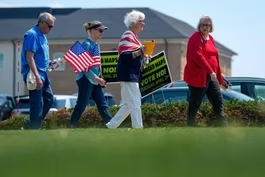
NewNews Wrap: Virginia voters approve new congressional map
Video has Closed Captions
News Wrap: Virginia voters approve new congressional map that could help Democrats (6m 43s)
 New
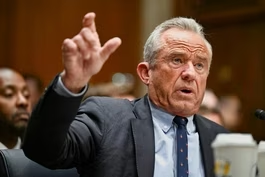
NewRFK Jr. defends vaccine guidance, health spending cuts
Video has Closed Captions
RFK Jr. defends vaccine guidance changes and health spending cuts (8m 41s)
 New
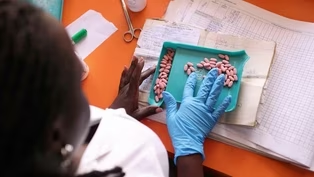
NewUganda sees spike in disease-related deaths after USAID cuts
Video has Closed Captions
Uganda sees spike in disease-related deaths after elimination of USAID (6m 38s)
Providing Support for PBS.org
Learn Moreabout PBS online sponsorship
- News and Public Affairs

FRONTLINE is investigative journalism that questions, explains and changes our world.

- News and Public Affairs

Today's top journalists discuss Washington's current political events and public affairs.












Support for PBS provided by:
Major corporate funding for the PBS News Hour is provided by BDO, BNSF, Consumer Cellular, American Cruise Lines, and Raymond James. Funding for the PBS NewsHour Weekend is provided by...